Ch 14. Capstone — A Domain Knowledge Graph + GraphRAG Pipeline
What you'll build
- An end-to-end pipeline tying together every piece from Parts 1–5
- Ontology design → graph construction → GraphRAG indexing → routed retrieval → evaluation
- A step-by-step checklist to run one domain of your own all the way through
Assumes
All of Parts 1–5. This chapter is integration, not new concepts.
1. Goal — one domain, all the way
We've learned the pieces separately. The capstone ties them to one domain. Small and concrete is better — an internal wiki, a set of product docs, 50 papers in a specific field. Ideally the very corpus where "vector RAG couldn't solve multi-hop/global questions."
For a first complete run, do not choose a new domain. Use the pharma-mini running project, regenerate the artifacts you kept through Parts 1–5 from an empty directory, then replace the corpus with your own domain.
2. The pipeline — 5 stages
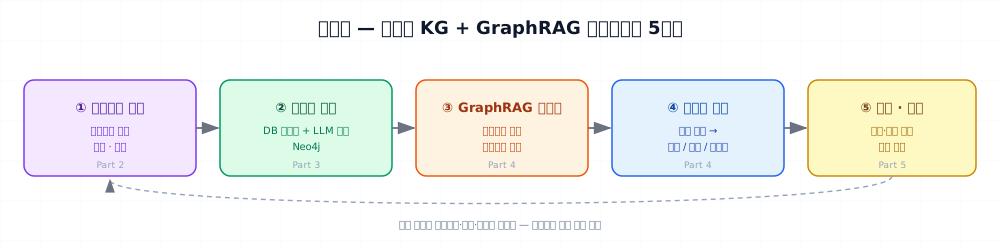
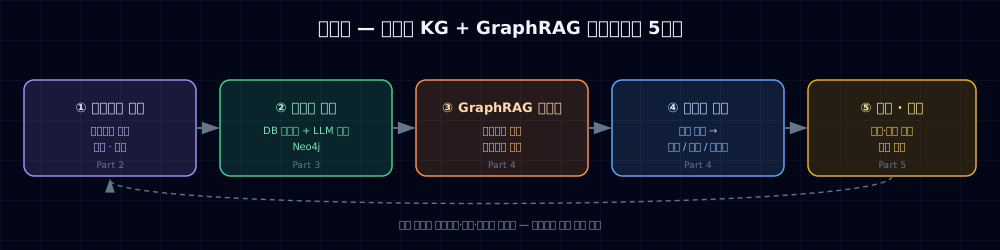
The whole picture follows this course directly.
① Ontology design      (Part 2)  competency questions → core concepts/relations
② Graph construction   (Part 3)  DB schema + LLM text extraction → Neo4j
③ GraphRAG indexing    (Part 4)  community detection → community summaries
④ Routed retrieval     (Part 4)  classify question → vector / local / global
⑤ Evaluation & ops     (Part 5)  retrieval/answer evaluation, incremental updates
3. Step-by-step checklist
① Ontology (Ch 4)
- Wrote 10–20 competency questions (reflecting real traffic).
- Settled on 5–10 core concepts and a relation-type list.
- Didn't over-engineer — only what the questions demand.
② Graph construction (Ch 5–Ch 8)
- If you have structured data, extracted the skeleton from the DB schema.
- Extracted unstructured text with the LLM using the ontology as a guardrail.
- Merged duplicate nodes with entity resolution (auto only the certain ones, review the rest).
- Pinned timestamps onto changing facts (where needed).
③ Indexing (Ch 9)
- Ran community detection.
- Generated per-community summaries (essential if you have global questions).
④ Retrieval (Ch 10–Ch 11)
- Added a router that classifies questions into factual/multihop/global.
- Local search gives graph facts + source chunks together.
- Factual questions go to cheap vector RAG.
⑤ Evaluation & ops (Ch 12–Ch 13)
- Built an eval set across the retrieval and answer layers.
- Compared against a vector-RAG baseline to confirm the questions where GraphRAG earns its keep.
- Set up an incremental update path (not full re-indexing).
Reproducibility gate
- In a fresh environment, regenerate
triples.jsonlfrom onlydocuments.jsonlandontology.yaml. - Record one row per question in
question-set.jsonl, including the evidencesource_idfor every answer. - Document the recommended retriever per question kind and failed cases in
decision.md. - Do not mark unexecuted GraphRAG features or performance claims as complete.
4. What you walk away with
Run this pipeline through once and you return to the opening question — "does this domain really need GraphRAG?" The answer is set by your corpus and question distribution. If it's mostly factual questions, vector RAG is enough; if multi-hop and global are central, the graph earns its keep. The capstone's real deliverable isn't just "a working GraphRAG" but a firsthand-validated judgment of when to reach for a graph.
5. Where to go next
- Deeper hybrid — vector entry + graph expansion, refined within a single question.
- Agent memory — Ch 8's time-aware graph as an agent's long-term memory.
- Ontology evolution — a loop that grows the ontology each time a new question type appears.
Closing
If vector RAG knows only "what's similar," a knowledge graph knows "how things connect." GraphRAG makes that connection retrievable, and its value lives in multi-hop and global questions. But it's no free lunch — routing by question, managing cost, and validating with evaluation are all part of one set.
Related guides: Ontology & Knowledge Graphs · Complete RAG Guide · AI Eval