Ch 10. Graph Retrieval Strategies — Local, Global, Community Summaries
What you'll learn
- Three retrieval modes that split by question type — local, global, hybrid
- Local search: gathering the neighborhood of a specific entity
- Global search: synthesizing community summaries with map-reduce
- The hybrid that finds an entry point with vectors and expands with the graph
Assumes
Indexing (graph + community summaries) from Ch 9.
1. Concept — the question decides the retrieval
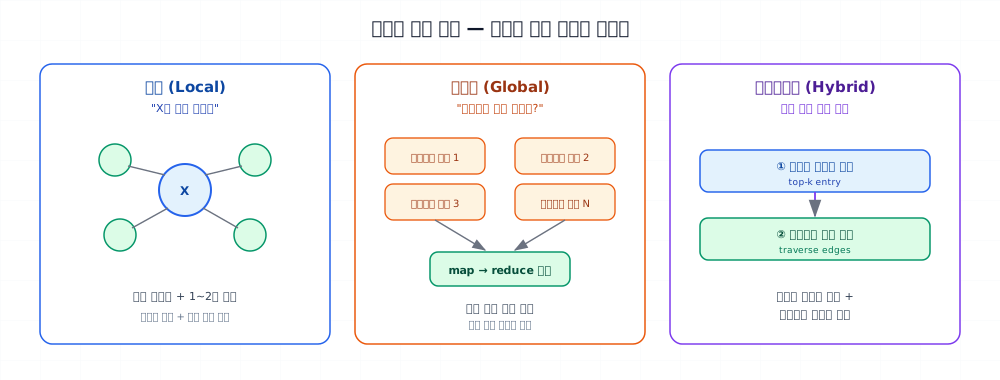
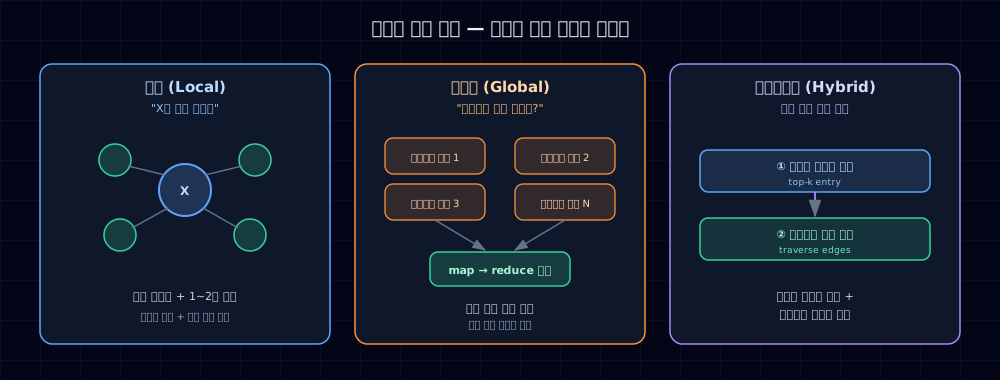
With the index ready (graph + community summaries), what remains is "what to pull when a question arrives." GraphRAG retrieval splits broadly in two by question type.
- Local — "tell me about this entity/topic." Explore around a specific node.
- Global — "what stands out across the whole." Synthesize community summaries.
Vector RAG doesn't distinguish these; it always returns "top-k similar chunks." GraphRAG picks the retrieval that fits the question.
2. Local search — gathering an entity's neighborhood
Use it when a specific entity is the center of the question. The procedure is intuitive.
- Find the entry entity from the question (name match, or the nearest node by embedding).
- Expand that node's neighborhood via the graph (1–2 hop relations, connected entities, related chunks).
- Hand the gathered context to the LLM to answer.
def local_search(question, entry_entity):
    ctx = run("""
    MATCH (e {name: $name})-[r]-(neighbor)
    OPTIONAL MATCH (e)-[:MENTIONED_IN]->(chunk:Chunk)
    RETURN e, collect(DISTINCT type(r) + ': ' + neighbor.name) AS facts,
           collect(DISTINCT chunk.text)[..5] AS snippets
    """, name=entry_entity)
    # combine facts (graph) + snippets (source text) into the prompt context
    return build_prompt(question, ctx)
The key is giving graph facts + source chunks together. The graph says "how things connect," the chunks are "the evidence from the source." You need both for multi-hop answers to be accurate and grounded.
3. Global search — map-reduce over community summaries
A global question like "what are this corpus's core themes?" has no entry entity. Instead you use the community summaries pre-built in Ch 9. A classic map-reduce.
- Map — for each community summary, the LLM produces a partial answer of "how this summary contributes to the question."
- Reduce — synthesize the partial answers into a final answer.
You synthesize only the summaries instead of re-reading all documents, so a "global" question becomes tractable at a realistic cost. Exactly the question vector RAG structurally couldn't do.
4. Hybrid — enter with vectors, expand with the graph
The most common real-world pattern mixes the two. Find an entry point with vector search, expand the neighborhood with the graph.
question → (vector) find top-k most relevant chunks/entities   ← entry
         → (graph) expand via that entity's neighbors/relations  ← multi-hop boost
         → answer with the combined context
It combines the vector's "flexible entry" with the graph's "precise expansion." This is the concrete form of "they're complementary, not competitors" from Ch 1.
| Question | Strategy |
|---|---|
| "Explain X" | Local |
| "How are X and Y connected" | Local (multi-hop) or hybrid |
| "What are the core themes overall" | Global |
| "Tell me everything about this keyword" | Hybrid |
5. Common failure points
Using global for everything. Global sweeps all community summaries, so it's expensive. Using global on an entity question (where local suffices) is just slow and costly. Classify the question first (routing).
Giving only graph facts, no source text. Graph triples alone leave the LLM short on context or unable to cite evidence. In local search, include the connected source chunks too.
Entry-entity match failure. If the question's wording differs from the graph node name, entry fails. Reinforce with embedding-based entity matching or an alias dictionary (connects to entity resolution in Ch 7).
6. Exercises & next
Check your understanding
- Write a rule for routing your question set into local/global/hybrid.
- If the global search's map step has 100 communities, how many LLM calls is that? How would you cut the cost?
Next
We've said GraphRAG is better in words. Now we compare it head-to-head with vector RAG on the same corpus and questions, and see where they diverge → Ch 11.
Sources
- Microsoft Research (2024). From Local to Global: A Graph RAG Approach to Query-Focused Summarization. arXiv:2404.16130
- Microsoft. GraphRAG: local & global search docs