Ch 9. What GraphRAG Is — Architecture and Indexing
What you'll learn
- GraphRAG's two stages — indexing (offline) and query (online)
- What indexing does: build the graph → detect communities → summarize communities
- Why indexing is expensive, and the question types that justify the cost
- The Microsoft GraphRAG pipeline in broad strokes
1. Concept — GraphRAG has two stages
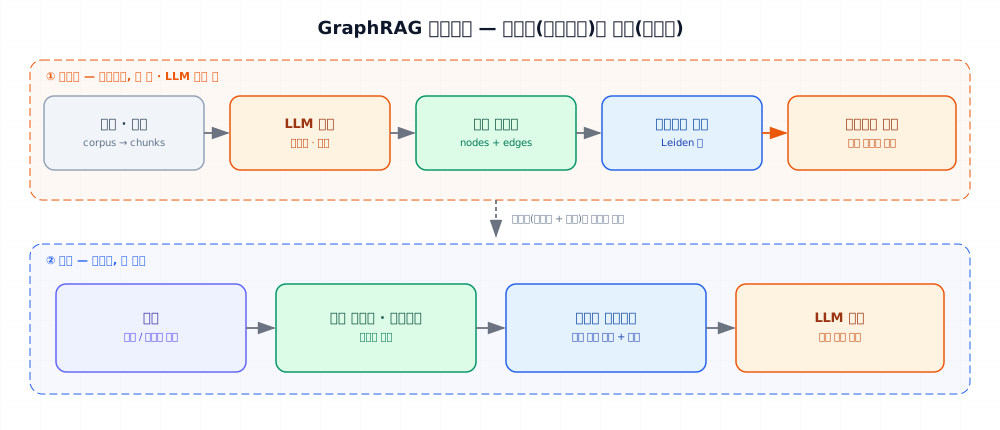
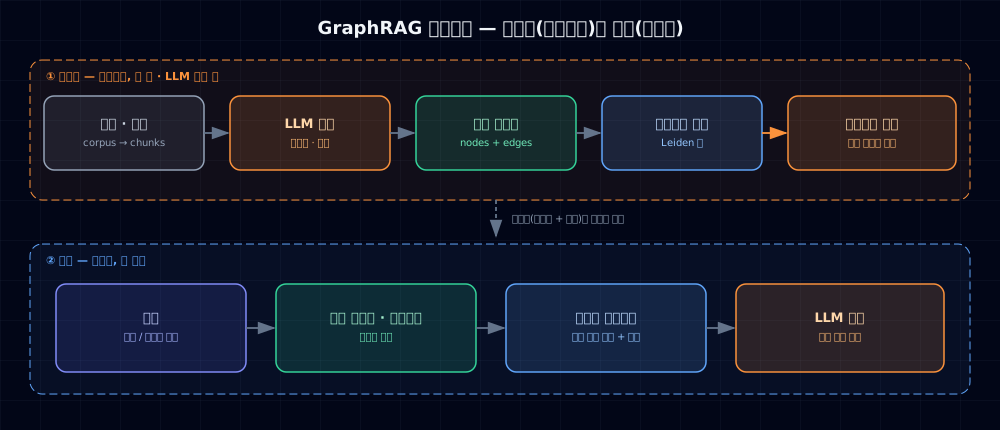
In Ch 1 we called GraphRAG "bolting the graph onto RAG to make connections retrievable." Like vector RAG, its structure splits into offline indexing and online query. The difference is that indexing builds not just embeddings but the graph and its summaries.
[ Indexing (offline, once · expensive) ]
  docs → chunks → (LLM) entity/relation extraction → knowledge graph
       → community detection → (LLM) per-community summaries

[ Query (online, per question) ]
  question → find relevant entities/communities → gather context via the graph → LLM answer
2. What indexing does
Three steps are key.
① Build the graph. Exactly as in Part 3 — extract entities and relations from chunks to build a knowledge graph. This is GraphRAG's skeleton.
② Detect communities. Split the graph into densely connected clusters (communities). Algorithms like Leiden find "nodes that connect heavily to each other" as a group. One community roughly corresponds to one topic/cluster (e.g., a "drugs, ingredients, diseases related to aspirin" cluster).
③ Summarize communities. An LLM pre-summarizes each community. This is the secret to the "global questions" from Ch 1 — when a question like "what are the overall themes?" arrives, instead of re-reading all documents you synthesize the pre-built community summaries.
3. Why it's expensive, and when it's worth it
Indexing is expensive. You sweep the whole corpus with an LLM to extract entities and relations, then generate a summary per community, so LLM calls accumulate in proportion to document volume. Far heavier than vector RAG's indexing (embeddings only).
So GraphRAG is no free lunch. If most questions are "find similar documents," this cost is waste. What justifies the indexing cost is the questions from Ch 1 — multi-hop, synthesis, and especially global summary. We compare this value/cost directly in Ch 11, and cost management is covered in Part 5's production chapter.
Microsoft GraphRAG
What popularized this indexing→community→summary pipeline is Microsoft Research's GraphRAG (2024). There's an open-source implementation, and many follow-on tools follow this structure. Details vary by implementation, but the "graph + community summaries" skeleton is common.
4. Common failure points
Re-running indexing every time. Indexing is an offline batch. Re-indexing the whole corpus every time a few documents change makes cost explode. You need an incremental update strategy (→ Part 5, production).
Skipping community summaries. Building only the graph without community summaries throws away GraphRAG's biggest strength, global questions. Fine if you only need multi-hop, but if you have "overall theme" questions, summaries are central.
5. Exercises & next
Check your understanding
- Split your domain's questions into "local (around a specific entity)" and "global (whole synthesis)." Which is more common?
- If indexing cost scales with document volume, at what corpus size / update frequency does GraphRAG become burdensome?
Next
With the index ready, how do you search the graph when a question arrives? On to local, global, and community strategies → Ch 10.
Sources
- Microsoft Research (2024). From Local to Global: A Graph RAG Approach to Query-Focused Summarization. arXiv:2404.16130
- Traag et al. (2019). From Louvain to Leiden: guaranteeing well-connected communities. (community detection)