파라미터·메모리 계산

이 챕터에서 배우는 것
- 파라미터 수 를 config 에서 손으로 계산 — embedding · attention · FFN 분해
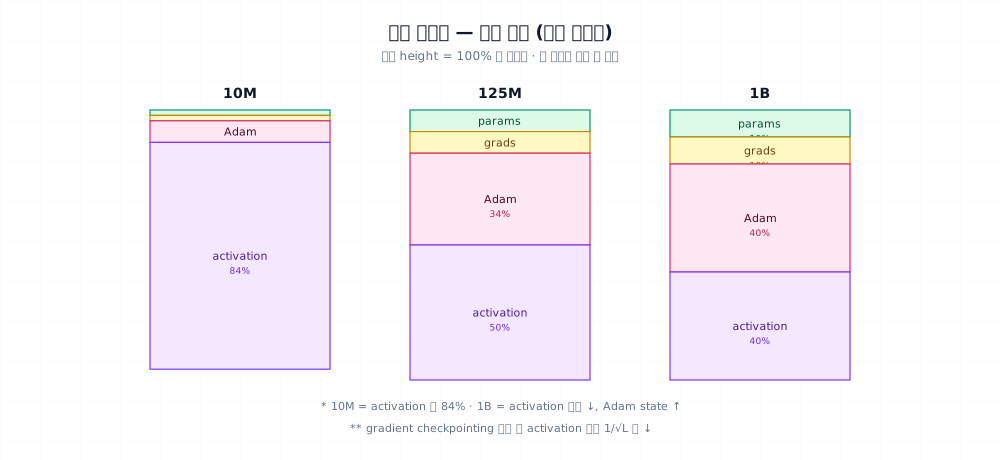
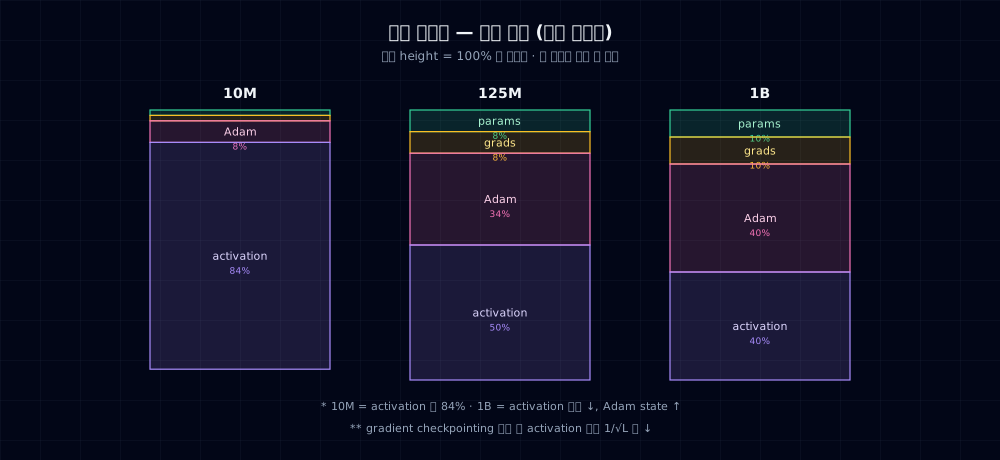
- 학습 메모리 = params + grads + optimizer state + activation. 식과 산수.
- 추론 메모리 = params + KV cache. seq · layer · head 함수.
- 본 책 10M 모델 / 30M / 125M 의 정확한 견적
전제
Ch 10 nanoGPT 의 코드 구조. Ch 3 노트북 예산 의 메모리 식 (14N) 을 본 챕터에서 분해.
1. 개념 — 어디에 메모리가 가나
학습 시 한 번의 step:
| 항 | 무엇이 메모리 | 크기 |
|---|---|---|
| params | 모델 가중치 자체 | 2N (bf16) |
| grads | 각 파라미터의 gradient | 2N |
| Adam m | 1차 moment (각 param) | 4N (fp32 권장) |
| Adam v | 2차 moment | 4N |
| activation | forward 의 중간 텐서, backward 위해 보관 | f(B, T, D, L) |
→ params 외 거의 모든 항이 N (param 수) 또는 batch · seq 의 함수. 어느 한 축이 늘면 그만큼.
추론 시는 더 가볍다 — params + KV cache 만.
2. 왜 산수가 필요한가
학습은 이미 시작한 뒤에 OOM 으로 죽으면 시간 손실 100%. 실제 학습 직전 30초 산수가 그 손실을 막는다.
또 한 가지: 같은 N=10M 이라도 config 가 달라지면 메모리가 다르다. 예:
- (n_layer=6, d_model=256, max_len=512) → activation 가벼움
- (n_layer=2, d_model=512, max_len=2048) → 같은 N 이지만 activation 4× 무거움
config 를 잡기 전에 분해 산수를 한다.
3. 어디에 쓰이나 — 책 전체에서
- 이 챕터 — 본 책 기준 모델 (10M) 의 견적
- Part 4 Ch 13 — mixed precision · grad accumulation 으로 메모리 1/2~1/4 줄이기
- Part 6 — int4 양자화로 추론 메모리 1/4
- Part 7 Ch 23 — 노트북에서 가능한 LoRA 베이스 크기 결정
4. 파라미터 수 분해
GPTMini 의 파라미터를 항별로:
Embedding
nn.Embedding(vocab, D) — vocab × D.
- 본 책 예: 8000 × 256 = 2.05 M.
weight tying (Ch 10) 면 lm_head 가 같은 가중치 사용 → 2배 안 듦.
Attention (한 layer)
qkv: Linear(D, 3D) + proj: Linear(D, D). bias 없음.
- 한 layer attention = 4 × D².
FFN (한 layer, SwiGLU)
w1, w3: Linear(D, H) + w2: Linear(H, D). H = (8/3) × D ≈ 2.67 D.
- 한 layer FFN = 3 × D × H ≈ 8 × D².
Norm (한 layer)
RMSNorm 에 gamma: (D,) 한 개. attention 전·FFN 전 두 번 → 2D. 무시할 수준.
한 layer 합계
attention 4D² + FFN 8D² + norm 2D ≈ 12 × D².
모델 전체
(weight tying 으로 lm_head 는 추가 안 됨)
본 책 기준 (V=8000, L=6, D=256)
embed:   8000 · 256       = 2,048,000
layers:  6 · 12 · 256²    = 4,718,592
norm:    256              = 256
─────────────────────────────────────
total                     ≈ 6.77 M  (★ 약 7M)
config 를 (L=6, D=320) 으로 바꾸면:
embed:   8000 · 320       = 2,560,000
layers:  6 · 12 · 320²    = 7,372,800
─────────────────────────────────────
total                     ≈ 9.93 M  (★ 약 10M, 본 책 기준선)
5. 학습 메모리 — 항별 산수
bf16 mixed precision 표준
| 항 | bytes/param | 7M 모델 (MB) | 10M (MB) | 125M (MB) |
|---|---|---|---|---|
| params (bf16) | 2 | 14 | 20 | 250 |
| grads (bf16) | 2 | 14 | 20 | 250 |
| Adam m (fp32) | 4 | 28 | 40 | 500 |
| Adam v (fp32) | 4 | 28 | 40 | 500 |
| 합계 (param 부분) | 12+2=14 | 84 | 120 | 1500 |
activation 메모리
forward 의 중간 텐서를 backward 위해 보관. 대략:
c 는 12~20 (블록 안 텐서 갯수, 구현 의존).
본 책 예 (B=32, T=512, D=320, L=6, c=14, fp16):
→ activation 이 메인 비용. params 와 비슷하거나 더 큼.
gradient checkpointing
activation 을 모두 저장하지 않고 backward 시 다시 계산. 메모리 1/√L 수준 (예: 840MB → 350MB), 시간 1.3× 정도 더. Part 4 Ch 13.
본 책 10M 학습 메모리 (총)
| 항목 | bf16 | gradient checkpointing |
|---|---|---|
| params/grads/Adam | 120 MB | 120 MB |
| activation (B=32, T=512) | 840 MB | 350 MB |
| 총 | 약 1 GB | 약 0.5 GB |
→ M2 (16GB), T4 (16GB), 무료 Colab (12GB) 모두 여유.
전형적 출력:
6. 추론 메모리 — KV cache
추론 시:
(2 = K + V, L=layer, H=head, d_h=head_dim, T=현재 seq, bytes=2 fp16)
본 책 10M (L=6, H=8, d_h=40, T=1024, fp16):
→ 무시할 수준. GQA 의 효과는 1B+ 부터 본격적.
비교 (Llama-3-8B, T=4K, fp16, GQA):
→ 큰 모델은 KV cache 가 본체급.
7. 자주 깨지는 포인트
1. embedding 을 빼먹는다 — D=512, vocab=32K 면 embedding 만 16M. 작은 모델일수록 비중 큼 (10M 모델에서 30%).
2. weight tying 안 함 — embedding 이 두 번 들어가 파라미터 2배. 학습도 불안정.
3. activation 추정에서 c 를 1로 — 실제 c 는 12~20. 메모리 10× 차이.
4. fp32 Adam state 를 fp16 으로 — 학습 발산 위험. Adam state 는 fp32 유지 가 표준 (mixed precision).
5. KV cache 를 batch 잊음 — 추론 batch=8 이면 KV cache 도 8×. 동시 사용자 수와 직결.
6. context 길이 외삽 시 KV cache 폭주 — RoPE 외삽 잘 돼도 KV cache 가 2× → 4× 로. 메모리는 외삽 안 됨.
8. 운영 시 체크할 점
학습 시작 전:
-
param_count()로 정확한 N -
train_mem_gb(N, B, T, D, L)로 학습 메모리 - 디바이스 RAM 의 70% 안 (30% 마진)
- activation 비중 확인 — 50% 넘으면 gradient checkpointing 검토
- B 또는 T 를 줄여서 다시 산수
- grad accumulation 으로 effective batch 보정 가능 (Part 4 Ch 13)
추론 시:
- KV cache (모델 + batch + seq 함수)
- 모델 양자화 시 params 1/4, KV cache 도 1/2 (보통 fp16 → int8)
- context 길이 한계 명시
9. 연습문제
- 본 책 기준 (V=8000, L=6, D=320) 의 파라미터 수를 손으로 계산하고
param_count()와 일치하는지 확인. - 같은 10M 인데 (L=2, D=560) 와 (L=12, D=180) 두 config 를 만들어 학습 메모리를 비교. 어느 쪽이 무거운가?
- activation 메모리 식의
c를 본인 nanoGPT 코드에서 직접 세보라. forward pass 에서 저장되는 중간 텐서 갯수를 기준으로. - Llama 3 8B GQA-8 의 KV cache 를 batch=4, T=8K 로 계산. 단일 A100 80GB 에서 동시 사용자 몇 명?
- (생각해볼 것) 같은 파라미터 N 이라면 (deep & thin) vs (shallow & wide) 중 어느 쪽이 메모리 효율적인가? activation 수식 관점에서.
Part 3 마무리
| 챕터 | 무엇을 |
|---|---|
| Ch 8 | Attention — 식 한 줄, 코드 5 줄 |
| Ch 9 | RoPE · RMSNorm · SwiGLU · GQA |
| Ch 10 | nanoGPT 100 줄 — 모델 한 파일 |
| Ch 11 | 파라미터 · 메모리 산수 |
다음 단계 → Part 4 노트북에서 훈련. 만든 모델을 굴리는 차례.
원전
- Kaplan et al. (2020). Scaling Laws for Neural Language Models. —
6NFLOPs, 메모리 분해 표준 - Rajbhandari et al. (2020). ZeRO: Memory Optimizations Toward Training Trillion Parameter Models. — Adam state 분해
- Chen et al. (2016). Training Deep Nets with Sublinear Memory Cost. — gradient checkpointing
- nanoGPT 의
train.py— 메모리 추정 패턴