What Differs from the API¶

What you'll learn
- What an API call hides and what running your own model exposes — tokenization, logits, sampling, memory
- A token-level comparison of GPT-4 API vs SmolLM2 local inference on the same prompt
- A decision tree for "API or self-hosted" — cost, latency, PII, and control
1. Concept — the line between an API call and a direct forward pass¶
When you call an API:
client.messages.create(model="claude-opus-4-7",
                       messages=[{"role":"user","content":"Can I get a refund?"}])
you see one blob of text back. Everything in between is a black box:
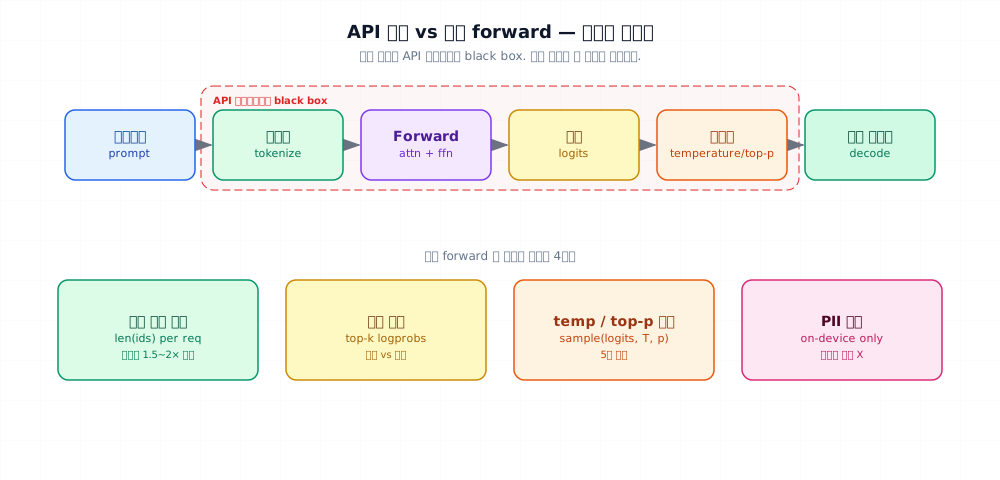
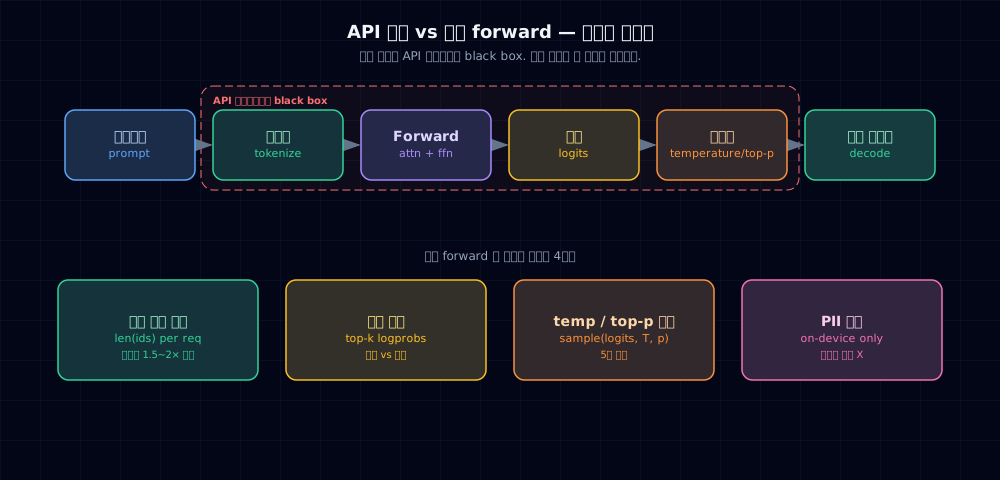
API users never see the grey zone. Run the model yourself and the boundary disappears — you see token IDs, attention tensors, logit distributions, and the effect of sampling parameters line by line.
This chapter makes that concrete. You'll look inside and see what appears.
2. Why it matters — five things the black box hides¶
(1) Tokenization¶
The same sentence splits differently across models. "Can I get a refund?":
| Tokenizer | Token count | Example tokens |
|---|---|---|
| GPT-4 (cl100k_base) | 7 | Can, I, get, a, ref, und, ? |
| Claude (proprietary) | ~5–8 | (not public) |
| SmolLM2 (Smol vocab) | 8 | Can, I, get, a, ref, und, ? |
| BPE 8K you'll train | varies | (depends on training data) |
Token count is cost, latency, and context window consumption. The "1,000 tokens = $X" pricing hides the fact that languages with more characters per concept — Korean, Japanese, Arabic — can cost 1.5–2× more per sentence than English. (Part 2 Ch 6 shows this directly by training your own tokenizer.)
(2) Logit distribution¶
To pick the next token, the model assigns a probability to every word in its vocabulary. The API samples one and returns it. Run the forward pass yourself and you see the full distribution:
Next token candidates (top-5)
  "Sure"      : 0.38
  "Of"        : 0.21
  "Yes"       : 0.14
  "Sorry"     : 0.08
  "Certainly" : 0.05
How peaked or flat this distribution is tells you how confident the model is. A flat distribution means "I'm not sure" — a hallucination warning signal. You can't see this through an API.
(3) How sampling parameters actually work¶
temperature=0.7 means: divide the logits by 0.7, then softmax. top_p=0.9 means: keep only enough top candidates to cover 90% of cumulative probability. API docs describe these abstractly, but the implementation is five lines. You'll write them in §5.
(4) The reality of memory and latency¶
A 2-second API response contains prefill (processing the input) + decode (generating one token at a time). 1,000 input tokens + 200 output tokens = 200 decode steps + 1 prefill step. Run the model yourself and you see both phases on a timeline.
(5) Where data goes (PII perspective)¶
An API call sends your data to an external server. Call-center transcripts full of PII, medical records, financial data — if it can't survive legal and compliance review, it can't go through an API. A self-hosted model stays inside your laptop or your company's GPU. This isn't a cost question. It's a data governance question.
3. Where each approach fits¶
| Situation | API wins | Self-hosted SLM wins |
|---|---|---|
| General-purpose chatbot | ◎ | △ (capability limits) |
| PII-heavy data (call center, medical, finance) | × (can't send) | ◎ |
| 100ms latency budget (mobile) | △ (network overhead) | ◎ (on-device) |
| Domain tone / brand voice | △ (with prompting) | ◎ (with training) |
| Classification / extraction (NER) | △ (overkill) | ◎ |
| Cost vs traffic | Per-call $0.01 | $0 variable cost (electricity + GPU only) |
| Hallucination control | Weak | Strong when domain is narrow |
| New capabilities / general reasoning | ◎ | × (capability ceiling) |
The pattern: (a) data can't leave your premises, (b) call volume is high enough that per-call cost hurts, (c) the domain is narrow and well-defined — two out of three of these and self-hosting becomes the right answer.
4. Minimal example — look inside token by token¶
Same prompt, tokenization + logits, no external API key required. SmolLM2-135M only, 30 seconds.
["Once", " upon", " a", " time"]— the space is a prefix of the next token, standard for GPT-style models.logits[0, -1]— the vocab-dimension distribution at the last sequence position.topkin one line. You can't get this from an API.
Typical output:
What you're seeing:
- The distribution is flat (top-1 is 18%). The model is uncertain, not committed.
- Five near-synonymous continuations — any of them would start a story naturally. That's the model's "opinion."
- An API response would give you just one, chosen at random from this distribution.
5. Hands-on tutorial — implement temperature and top-p yourself¶
temperature and top_p sound abstract in API docs. Written out as code, they're five lines each. Implement them and verify they match what the API describes.
- T=1 leaves the distribution unchanged. T<1 sharpens it (more confidence). T>1 flattens it (more variety).
- Top-k keeps only the k highest logits. Simple.
- Top-p (nucleus) keeps only enough top tokens to cover probability mass p. The number of candidates varies with the distribution shape.
Experiment: run the same prompt with temperature set to 0.3, 0.7, and 1.2, three times each:
for T in [0.3, 0.7, 1.2]:
    print(f"\n--- T={T} ---")
    for _ in range(3):
        ids = tok(prompt, return_tensors="pt").input_ids
        for _ in range(20):
            with torch.no_grad():
                logits = model(ids).logits[0, -1]
            nxt = sample(logits, temperature=T, top_p=0.9)
            ids = torch.cat([ids, torch.tensor([[nxt]])], dim=1)
        print(tok.decode(ids[0]))
What you'll see:
- T=0.3 — nearly identical output every time. "Once upon a time, there was a little girl..." repeats.
- T=0.7 — standard fairy-tale tone, different each time. APIs typically default to this range.
- T=1.2 — occasional broken sentences, sudden topic shifts. The creativity-vs-stability tradeoff becomes tangible.
You just verified by hand something you'd otherwise only estimate from API behavior. This is the starting point for the attention and logit deep-dive in Part 5.
6. Common pitfalls¶
1. "Self-hosting always cuts API costs." Not always. If your traffic is low, one GPU (a few hundred dollars a month) costs more than API calls at that volume. Break-even = (monthly GPU cost) / (per-call API cost). 100K calls per day: self-hosting wins. 1K calls per day: API wins.
2. "Self-hosted means lower latency." Only if the model is small enough. A self-hosted 7B model vs. the Anthropic API: the API can be faster (dedicated hardware, batching). Latency scales primarily with model size × token count.
3. "You can prompt your way to anything." Prompts handle domain tone, forbidden phrases, and structured output. PII containment, hallucination isolation, and 100ms latency aren't prompt problems — they're questions of where the model lives.
4. "Self-hosted models hallucinate less." Not automatically. Hallucination drops when the domain is narrow and the training data is well-curated. A small model trained carelessly hallucinates more, not less. (Part 5 Ch 16 covers this.)
5. Forgetting to count tokens correctly. Using len(text) to estimate cost is wrong by roughly 2× for English and more for other languages. Always tokenize and count the actual token IDs.
7. Production checklist — decision tree¶
When a new task arrives, decide in 30 seconds:
| Question | Yes | No |
|---|---|---|
| Does the data contain PII that can't leave your network? | Self-host | Next |
| More than 100K calls per day? | Consider self-hosting | Next |
| 100ms latency budget? | Self-host (small model) | Next |
| Narrow domain with available training data? | Self-host (LoRA, Part 7) | Next |
| General reasoning / code / multilingual? | API | Consider self-hosting |
Once the checklist points to "self-host":
- Which model size? (See Ch 3 device table)
- Training data source + license + PII policy? (Part 8 Ch 29)
- Eval set + regression? (Part 5 + Part 8 Ch 30)
- Serving stack + latency budget? (Part 8 Ch 31)
- Monitoring + cost model? (Part 8 Ch 32)
The rest of this book answers every item on that checklist.
8. Exercises¶
- Take five prompts you use regularly and tokenize them with both SmolLM2's tokenizer and GPT-4's tokenizer (
tiktoken). Compare token counts. Pick the one with the biggest gap and explain why in one sentence. - Run
peek_inside.pyfrom §4 on a non-English prompt. Compare the top-1 probability to what you saw with an English prompt. What's different? - Add
repetition_penaltyto the sampling function in §5 (divide already-seen token logits bypenalty). Verify it reduces repetition when T=0.3. - (Think about it) Pick one task from your actual work. Run it through the §7 decision tree. If it lands on "self-host," compute the break-even traffic. If it lands on "API," identify which single condition change would flip it to "self-host."
Sources¶
- OpenAI tokenizer (cl100k_base) —
tiktokenlibrary - HuggingFace
transformersgenerate()source — sampling implementation reference - Holtzman et al. (2019). The Curious Case of Neural Text Degeneration. — top-p (nucleus) paper
- Karpathy. Let's build GPT: from scratch (YouTube, 2023) — live sampling implementation
- nanoGPT
sample.py— same pattern in under 100 lines