Classification and NER Fine-tuning (Encoder)

What you'll learn
- Decoder vs Encoder — why encoders win on classification and NER
- Korean options: KoELECTRA, klue/bert-base, xlm-roberta-base
- Token classification head + IOB tagging
- Mini domain entity extraction — pulling phone numbers, amounts, product names, and contract IDs from call transcripts
Prerequisites
Ch 8 Attention — the mask difference. Ch 23 Decision Tree.
1. Concept — Decoder vs Encoder
| Architecture | Mask | What token i sees | Suited for |
|---|---|---|---|
| Decoder (GPT) | causal | 0..i (itself + past) | generation |
| Encoder (BERT) | none | 0..T (entire sequence, bidirectional) | classification / NER / extraction |
Classification and NER require each token to see full left and right context to be accurate. Encoders are the natural fit.
A decoder can classify too (use the final hidden state → classification head), but an encoder of the same size usually wins.
2. Why Encoders Win Here
| Aspect | decoder (3B) | encoder (110M) |
|---|---|---|
| Bidirectional context | × | ◎ |
| Inference speed | slow (autoregressive) | fast (one forward pass) |
| Memory | large | small |
| Classification accuracy (same task) | comparable | usually 1–3% better |
In production environments like call center NER: encoders are the right choice — fast, small, and accurate.
3. Korean Encoder Options
| Model | Parameters | Notes | License |
|---|---|---|---|
| klue/bert-base | 110M | KLUE benchmark base, Korean-focused | Apache 2.0 |
| monologg/koelectra-base-v3-discriminator | 110M | KoELECTRA, Korean SOTA encoder | Apache 2.0 |
| xlm-roberta-base | 270M | 100 languages | MIT |
| xlm-roberta-large | 550M | Larger version, better NER scores | MIT |
Default recommendation: klue/bert-base — Korean only, small, clean.
For special domains (call center, medical), continued pre-training before fine-tuning is the right approach — but this book covers fine-tuning only.
4. Task Definition — IOB Tagging
Call transcript NER example:
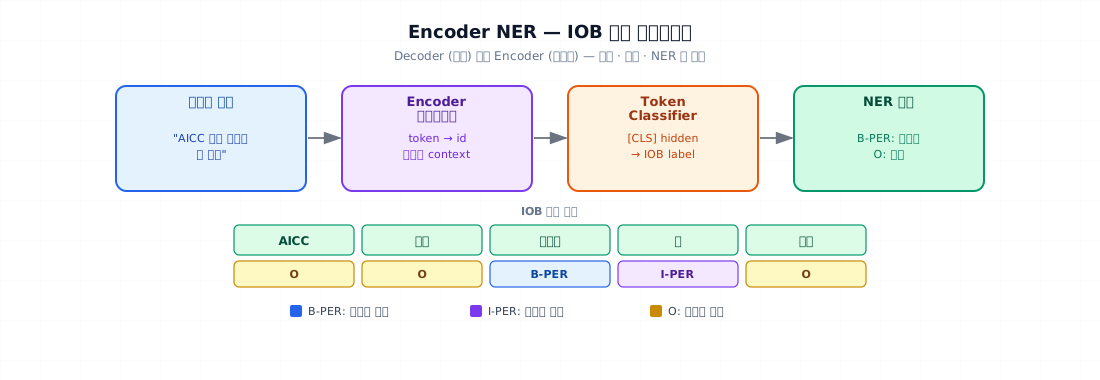
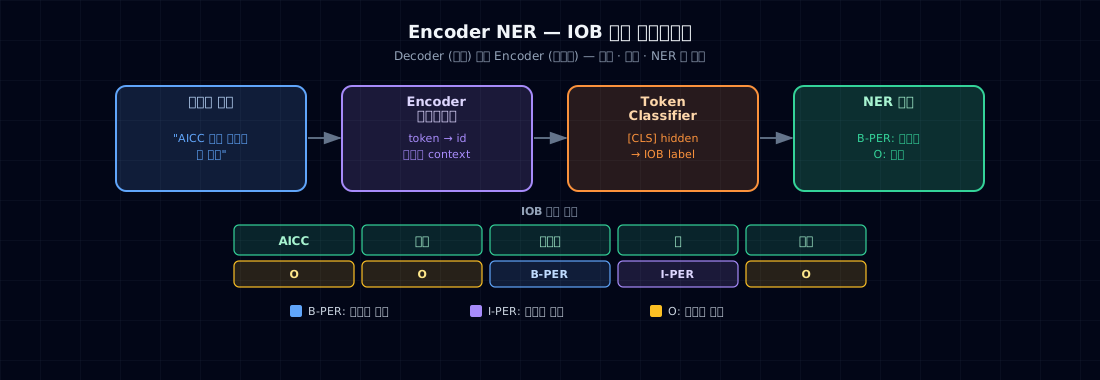
Input: "Please refund 140,000 won to my mobile number 010-1234-5678"
Output:
  Token            Tag
  Please           O
  refund           O
  140,000          B-MONEY
  won              I-MONEY
  to               O
  my               O
  mobile           O
  number           O
  010              B-PHONE
  -                I-PHONE
  1234             I-PHONE
  -                I-PHONE
  5678             I-PHONE
Tag structure (BIO/IOB):
- B- Begin (entity start)
- I- Inside (entity continuation)
- O Outside (not an entity)
This chapter's mini NER has 4 entity types:
| Entity | Example |
|---|---|
| PHONE | 010-1234-5678 |
| MONEY | 140,000 won, 50,000 won |
| PRODUCT | Galaxy S25, iPhone 16 |
| CONTRACT | Contract number KR-2026-001 |
5. Synthetic Data — Start with 100 Sentences
100 sentences ≈ 5 minutes, about $0.05. For real use, 1,000+ is recommended.
Span → IOB Conversion
6. Training with transformers Trainer
Training time: T4, 1000 pairs × 5 epochs ≈ 10 minutes.
7. Inference + F1 Evaluation
Typical results (trained on 1000 pairs):
              precision    recall  f1-score
PHONE             0.97      0.95      0.96
MONEY             0.92      0.88      0.90
PRODUCT           0.85      0.82      0.83
CONTRACT          0.94      0.93      0.93

micro avg         0.92      0.89      0.91
100 pairs → F1 around 0.7. 1,000+ pairs → F1 around 0.9.
8. Common Failure Points
1. Char-span to token IOB conversion mistakes — Use return_offsets_mapping=True to handle this automatically. Watch for WordPiece sub-word boundaries.
2. Label imbalance — When O makes up 90% of labels, learning B-/I- tags is hard. Use class weights or adjust entity ratio when generating synthetic data.
3. Learning rate too high — Encoder fine-tuning standard is 3e-5. Above 1e-4, training diverges.
4. Too few or too many epochs — 1,000 pairs × 5 epochs is a good balance. 100 pairs × 30 epochs also works (watch for overfitting).
5. Eval distribution differs from training — If you generate synthetic training data but evaluate on real logs, the domain gap will hurt. Label at least 100 real log samples separately.
6. Missing post-processing on NER output — Without aggregation_strategy="simple", you get per-subword outputs. Use pipeline as the standard.
7. Using NER where ITN is needed — "zero one zero" → "010" is a transformation, not a classification. Seq2seq (Ch 28) is the answer there.
9. Ops Checklist
NER model ops gate:
- Define entity types (4–10)
- 1,000+ training pairs (mix synthetic + real logs)
- 100+ evaluation pairs (real logs)
- F1 ≥ 0.85 (practical threshold)
- Per-label F1 breakdown (which entity type is weakest)
- Inference speed (single batch, p95)
- Write model card (Ch 22's 7-item checklist)
- (Part 8, Ch 30) Regression eval + drift monitoring
10. Exercises
- Define 4 entity types for your own domain, generate 100 synthetic pairs, and train klue/bert-base. Measure F1.
- Compare KoELECTRA vs klue/bert vs xlm-roberta on the same data. How different is the F1?
- Train with 100 / 500 / 1000 / 5000 samples. Plot the F1 learning curve.
- Compare inference speed — this book's NER model vs Qwen 2.5-0.5B LoRA for NER (p95 latency).
- (Think about it) Could you implement ITN as "encoder NER + post-processing rules"? What are the trade-offs vs seq2seq?
References
- Devlin et al. (2018). BERT. arXiv:1810.04805
- Park et al. (2020). KoELECTRA. GitHub
- Park et al. (2021). KLUE. arXiv:2105.09680
- Conneau et al. (2019). XLM-R. arXiv:1911.02116
- HuggingFace
seqeval— entity-level F1