From Scratch vs Fine-tuning

What you'll learn
- From scratch vs fine-tuning — the decision tree
- Memory math for fine-tuning on a laptop (Ch 11 applied)
- Continued pre-training vs SFT vs LoRA — where each one fits
- Why the capstone takes the LoRA path
Prerequisites
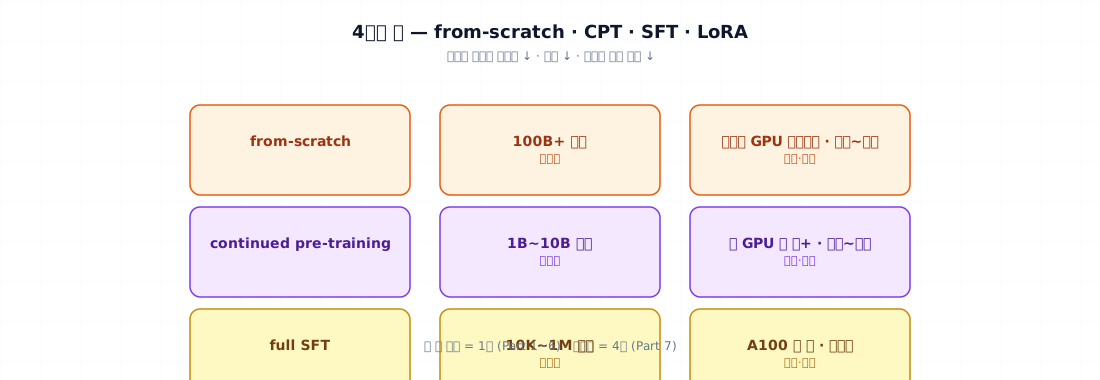
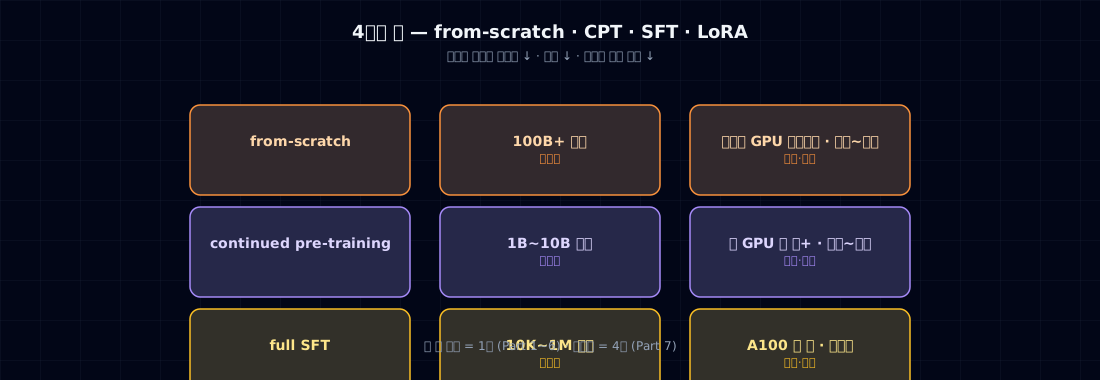
1. Concept — Four Paths
| Path | Starting point | Data needed | Cost |
|---|---|---|---|
| From-scratch | random init | 100B+ tokens | very high |
| Continued pre-training | off-the-shelf base | 1B–10B domain tokens | high |
| Full fine-tuning (SFT) | base/instruct | 10K–1M pairs | medium |
| LoRA / QLoRA | base/instruct | 100–10K pairs | low |
Going down the list: (a) less data, (b) faster and cheaper, (c) less domain adaptation power.
Where this book sits:
- Parts 1–6: from-scratch (10M)
- Part 7 + capstone: LoRA (on Qwen 2.5-0.5B)
2. Decision Tree
1. Is the domain general enough that an off-the-shelf model already covers it?
   Yes → Use the Ch 22 decision tree → done (no LoRA needed either)
   No  → continue

2. How much domain data do you have?
   100B+ tokens        → from-scratch (requires large GPU cluster)
   1B–10B tokens       → continued pre-training
   10K–1M pairs        → full SFT or LoRA
   100–10K pairs       → LoRA / QLoRA

3. Does it need to fit on a laptop?
   Yes → LoRA / QLoRA (Ch 24)
   No  → full SFT is possible (single A100+)

4. Does the license need to stay separate? (share only the adapter)
   Yes → LoRA (adapter saved independently)
   No  → full SFT is fine too
3. How Much Fine-tuning Fits on a Laptop
From Ch 11, the memory formula is 14N — but for LoRA, N refers to the adapter size, not the full model.
Full SFT memory
| Base model | params (bf16) | grads | Adam | activations (B=4, T=1024) | total |
|---|---|---|---|---|---|
| 0.5B | 1.0 GB | 1.0 GB | 4.0 GB | 1.5 GB | 7.5 GB |
| 1.5B | 3.0 GB | 3.0 GB | 12 GB | 3 GB | 21 GB |
| 3B | 6.0 GB | 6.0 GB | 24 GB | 5 GB | 41 GB |
| 7B | 14 GB | 14 GB | 56 GB | 10 GB | 94 GB |
T4 (16 GB): only 0.5B fits for full SFT. A100 (80 GB): up to 7B.
LoRA memory
LoRA freezes the base weights and trains only a small adapter. At r=16, the adapter is under 1% of the base.
| Base model | base (bf16, frozen) | LoRA params/grads/Adam | activations | total |
|---|---|---|---|---|
| 0.5B | 1.0 GB | 0.05 GB | 1.5 GB | 2.5 GB |
| 1.5B | 3.0 GB | 0.15 GB | 3 GB | 6 GB |
| 3B | 6.0 GB | 0.3 GB | 5 GB | 11 GB |
| 7B | 14 GB | 0.7 GB | 10 GB | 25 GB |
T4 (16 GB): 3B LoRA fits. Laptop (24 GB+): 7B LoRA fits.
QLoRA memory
Quantize the base to int4 → memory cut to 1/4.
| Base model | base (int4) | LoRA + activations | total |
|---|---|---|---|
| 7B | 3.5 GB | 8 GB | 11.5 GB |
| 13B | 6.5 GB | 12 GB | 18.5 GB |
| 70B | 35 GB | 30 GB | 65 GB |
T4 (16 GB): 7B QLoRA fits. A100 (80 GB): 70B QLoRA fits.
4. The Book's Capstone Decision
Capstone (Korean fairytale generator):
1. Does a general Korean model suffice?       No → fairytale domain needs specialization
2. How much data?                             5K–50K synthetic fairytale pairs
3. Does it need to fit on a laptop?           Yes → LoRA / QLoRA
4. License separation needed?                Yes (only the adapter goes to HF Hub)
Answer: LoRA on Qwen 2.5-0.5B-Instruct.
Model size choice:
- 0.5B is fast for laptop inference (10+ tokens/sec on M2 CPU)
- 1.5B gives better capability but slower inference
- Start with 0.5B → scale up to 1.5B if results aren't good enough
5. Common Failure Points
1. "Full SFT is always better than LoRA" — With under 10K examples, LoRA performs almost the same and is more stable. SFT overfits on small datasets.
2. Getting drawn to from-scratch — If you've worked through Parts 1–6, you know training a 1B+ model takes days. It won't fit your schedule.
3. Not enough data for continued pre-training — Below 1B tokens, the effect is negligible. You need that much domain raw text to justify CPT.
4. Running continued pre-training on an instruct model — CPT belongs on a base model. Instruct models have already been SFT'd — CPT breaks their format.
5. Assuming bigger r is better — r=64+ inflates memory and causes overfitting. r=8–16 is the standard.
6. Skipping memory math — A100 results don't transfer directly to a laptop. Do the math first.
6. Ops Checklist
After making the decision:
- Choose one of the four paths (via the decision tree)
- Decide on base model (Ch 22)
- Data volume + format (raw text vs pairs)
- Memory math (Full vs LoRA vs QLoRA)
- Estimate training time (Ch 3, Ch 15 patterns)
- Decide evaluation method (Part 5)
- (Optional) Compare full SFT vs LoRA in an experiment
7. Exercises
- Measure your domain dataset (pairs or token count). Which of the four paths fits?
- Calculate LoRA memory for 0.5B / 1.5B / 3B on your GPU.
- Train SmolLM2-360M on 100 pairs with LoRA vs full SFT (if feasible). How different are the results?
- (Think about it) How does having built the 10M from-scratch model shape your intuition when deciding to LoRA a 1.5B? What does "building it yourself" give you that reading a tutorial wouldn't?
References
- Hu et al. (2021). LoRA. arXiv:2106.09685
- Dettmers et al. (2023). QLoRA. arXiv:2305.14314
- Gururangan et al. (2020). Don't Stop Pretraining. arXiv:2004.10964 (continued pre-training)
- HuggingFace
peftlibrary docs