The Open-Weight SLM Landscape — Size, Dense, MoE¶

What you'll learn
- Why open-weight SLMs ship at 135M / 360M / 1.7B / 3B / 7B — scaling laws and practical thresholds
- The dense vs MoE distinction — what "parameter count" means differently in each form
- The 2026 map: Phi-3, SmolLM2, Gemma 2, Qwen 2.5, Llama 3.2, Mixtral, DeepSeek-V3, Phi-3.5-MoE
- Where this book's 10M model sits — you'll train dense; you should know the whole landscape
Prerequisites
The tier table from Ch 1 The Return of Small Models and the memory/time math from Ch 3 What Your Laptop Can Do.
1. Concept — the size ladder has reasons¶
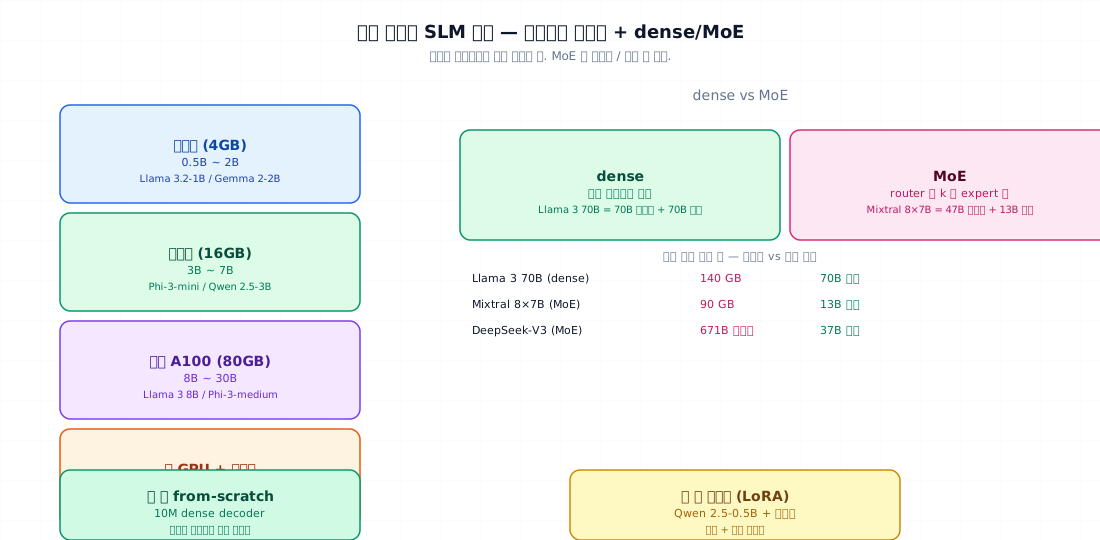
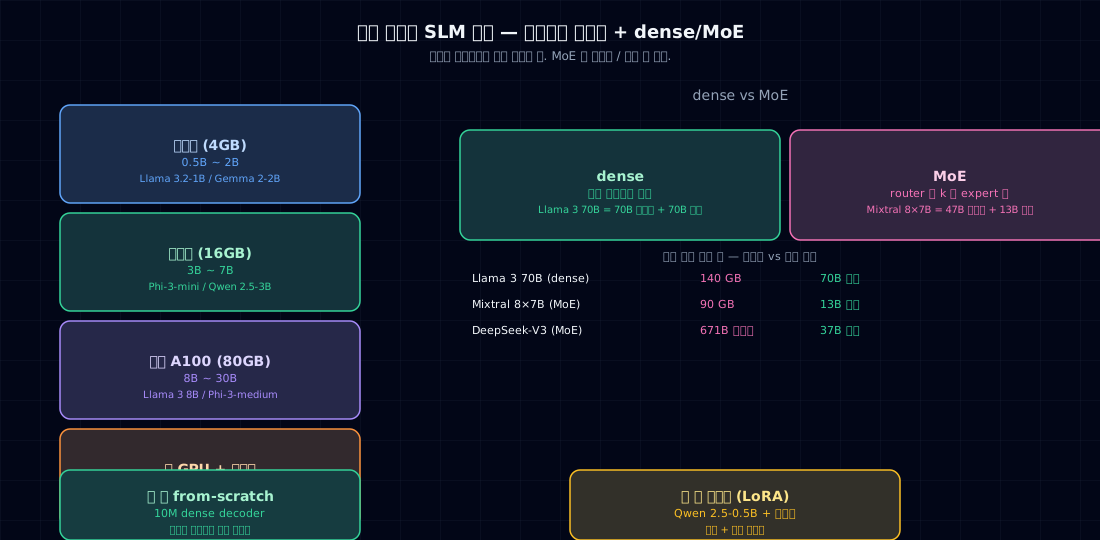
Open-weight SLMs don't appear at random sizes. There's a deliberate cut for each rung of the mobile / laptop / single GPU / large GPU / server cluster device ladder.
| Target device | Recommended size | Examples |
|---|---|---|
| Mobile (4 GB RAM, int4) | 0.5B – 2B | SmolLM2-1.7B, Gemma 2-2B, Llama 3.2-1B/3B |
| Laptop (16 GB, int4/int8) | 3B – 7B | Phi-3-mini 3.8B, Mistral 7B, Qwen 2.5-3B |
| Single A100 (80 GB, fp16) | 8B – 30B | Llama 3 8B, Phi-3-medium 14B, Qwen 2.5-32B |
| Large GPU + quantization | 70B (int4) | Llama 3 70B, Qwen 2.5-72B |
| Server cluster | 100B+ | Llama 3.1-405B, DeepSeek-V3 |
Each cut is determined by what fits in device RAM at inference time. Training a model requires the next tier up.
2. Why the same name comes in multiple sizes¶
The same organization shipping the same model family at many sizes is now standard — Llama 3 at 1B/3B/8B/70B, Qwen 2.5 at 0.5B/1.5B/3B/7B/14B/32B/72B. Two reasons:
(1) Covering the device ladder¶
Each model family covers every device tier with one variant. Users pick "the biggest one that fits my device."
(2) Capability-vs-cost tradeoff per task¶
If a task is 80% solvable with a 1B model, there's little reason to run 7B. Offering multiple sizes lets users find the smallest sufficient size for each workload.
Why ~1B is a threshold¶
Empirical findings from Chinchilla (Hoffmann et al., 2022) and subsequent over-training research:
- Below 300M — even general English text is inconsistent. Narrow domains like TinyStories are needed for coherence.
- 300M – 1B — general text sounds natural, but reasoning and code are weak. SmolLM2-1.7B sits near this threshold.
- 1B – 3B — short-step reasoning and simple tool calls become possible. Llama 3.2-1B/3B, Gemma 2-2B territory.
- 3B – 7B — "usable general chatbot" starts here. Phi-3-mini 3.8B, Mistral 7B.
- 7B+ — code, complex reasoning, multilingual all open up. Llama 3 8B, Qwen 2.5-7B.
These thresholds explain why different companies converge on the same sizes. Llama 3.2-1B, Qwen 2.5-1.5B, and Gemma 2-2B clustering near the same point isn't coincidence.
3. Dense vs MoE — what "parameter count" means differently¶
All the models above are dense — every token passes through every parameter. MoE (Mixture of Experts) works differently.
How MoE works¶
Replace the feed-forward block with N expert networks and a router. For each token, the router selects k out of N experts to activate (typically k=2). Only a fraction of the total parameters do work per token. That fraction is called the active parameters.
Two numbers you need¶
| Model | Total parameters | Active parameters | Inference memory | Inference speed |
|---|---|---|---|---|
| Mixtral 8×7B | 47B | 13B only | ~90 GB (47B fp16) | ~13B dense |
| Phi-3.5-MoE | 42B | 6.6B | ~42B scale | ~6.6B dense |
| DeepSeek-V3 | 671B | 37B | ~671B scale | ~37B dense |
| Llama 3 70B (dense, for comparison) | 70B | 70B | ~140 GB | 70B scale |
The key point:
- Memory = total parameters — you need VRAM for all 47B to run Mixtral, regardless of which experts are active.
- Speed = active parameters — Mixtral runs at roughly 13B-dense speed, not 47B-dense speed.
- MoE is therefore expensive on memory, cheap on compute — ideal for data centers, not for laptops.
Why MoE doesn't work as a laptop SLM¶
Mixtral 8×7B needs ~90 GB of VRAM. Quantized to int4, still 24 GB+. A laptop can't hold it.
Exception: small MoEs like Phi-3.5-MoE can fit on a laptop when quantized. But this book covers only dense models — the training code and memory math stay simpler. MoE gets names and meanings here, nothing more.
The 2024–2025 trend: MoE going mainstream¶
- DeepSeek-V3 (December 2024) — 671B total / 37B active, open-weight.
- Mixtral series (Mistral, 2023–2024) — started the open-weight MoE era.
- Several closed-weight models (Qwen-Max, etc.) are also reportedly MoE.
- MoE is becoming the default architecture for training efficiency at large scale.
The current split: the largest model families go MoE; models from 1B to 7B stay dense. That's the distribution in 2026.
4. Where to look — reading a model card in 30 seconds¶
When picking an open-weight model, check these seven items on the HuggingFace model card:
| Item | Where to find it | Why it matters |
|---|---|---|
| Total parameters | First line of model card | Determines memory |
| Active parameters (MoE) | "active params" / "experts" field | Determines speed and cost |
| Training token count | Model card or paper | Degree of over-training |
| Training data composition | Card or blog post | Predicts strengths and weaknesses (multilingual, code) |
| Context length | config.json → max_position_embeddings |
Feasibility for RAG and long documents |
| License | Top of card | Commercial use allowed? |
| Tokenizer | tokenizer_config.json |
Non-English efficiency |
These seven decide "can I use this?" in 30 seconds. A full decision tree is in Ch 22 Choosing and Using an Off-the-Shelf sLLM.
5. Minimal example — same prompt across five models¶
Feed the same prompt to five dense models (and one MoE if you have an A100) to see the capability curve.
What to look for:
- 135M–360M: output breaks down if the prompt is non-English (training data was overwhelmingly English).
- SmolLM2-1.7B: handles English, summary quality is inconsistent.
- Qwen 2.5-0.5B / 1.5B: multilingual capability is markedly different — Qwen trained on a much larger multilingual corpus.
- Mixtral (if you have an A100): check whether active-13B quality matches dense-13B quality.
Working intuition: "small model + non-English" → Qwen 2.5 typically outperforms SmolLM2 at the same size, because of training data differences.
6. Where this book's 10M model sits¶
This book builds a dense, 10M, decoder-only model. Its coordinates:
Parameters:  ~10M  (much smaller than any production SLM)
Architecture: decoder-only (not encoder like BERT)
Form:        dense (not MoE)
Domain:      narrow (TinyStories English stories)
What that position means:
- The build process is identical to a 1B–7B dense SLM — same nanoGPT architecture, same training loop, same evaluation.
- What you won't see: MoE router training (outside this book's scope), bidirectional encoder masking (Ch 25, briefly), seq2seq cross-attention (Ch 28, briefly).
- When you LoRA a 1B SmolLM2 in Part 7, everything you learned building the dense 10M transfers directly.
7. Common pitfalls¶
1. Confusing total and active parameter counts. Mixtral 8×7B needs 47B-model-scale VRAM at inference — not 7B-scale. Always use total parameters to decide whether a model fits on your device.
2. Same size ≠ same capability across families. Llama 3.2-1B, Qwen 2.5-1.5B, and Phi-3.5-mini are all "roughly 1B" but trained on different data. Multilingual, reasoning, and code performance differ significantly. Card + benchmarks + your own test is the only reliable answer.
3. Assuming MoE is always better. MoE is the right answer when memory is abundant and compute speed matters. When memory is the constraint, dense wins. Laptop = dense territory.
4. Ignoring training token counts. A 1B model trained on 100B tokens and the same model trained on 1T tokens are different models. SmolLM2-1.7B squeezes performance from its size precisely because it trained on 11T tokens.
5. Skipping the license. Llama 3 has a 700M MAU limit. Gemma has its own license. Qwen 2.5 is mostly Apache 2.0. Phi-3 is MIT. Always check before deploying commercially.
8. Production checklist — 30-second new model evaluation¶
When a new open-weight model drops:
- Total vs active parameters (same for dense; separate for MoE)
- Training token count + data composition (English / multilingual / code ratios)
- Context length + RoPE variant (does it support extrapolation?)
- Tokenizer — measure non-English token efficiency (see Ch 6)
- License — commercial use, redistribution, and fine-tuning rights
- Quantization — fp16 → int4 GGUF is the standard path
- Does it fit in your device's RAM? (total parameters, not active)
9. Exercises¶
- Read the model cards for
HuggingFaceTB/SmolLM2-1.7BandQwen/Qwen2.5-1.5B. Fill in all seven items from §4. Which one has an edge for non-English text, and why? - Mixtral 8×7B is described as "47B total / 13B active." If there are 8 experts and each is 7B, you'd expect 56B — not 47B. How does the math work? (Hint: shared parameters.)
- Pick one of SmolLM2-1.7B, Qwen 2.5-1.5B, or Gemma 2-2B for the capstone. Write three sentences explaining your choice plus whether it fits in your laptop's RAM after quantization.
- If your company were to build a proprietary SLM, which size — 1B, 3B, or 7B — would you target? Justify using the device ladder and a rough ROI argument.
- (Think about it) Where does the training cost difference between dense and MoE actually come from? If both have 13B active parameters per token, shouldn't training cost the same?
Part 1 wrap-up¶
| Chapter | Covered |
|---|---|
| Ch 1 | Three forces behind the SLM revival |
| Ch 2 | API call vs direct forward pass |
| Ch 3 | Laptop budget math |
| Ch 4 | Open-weight landscape — size, dense, MoE |
Next → Part 2 Data & Tokenizer. Before touching the model, decide what to feed it.
Sources¶
- Hoffmann et al. (2022). Training Compute-Optimal LLMs. (Chinchilla) arXiv:2203.15556
- Mistral AI (2024). Mixtral of Experts. arXiv:2401.04088
- Abdin et al. (2024). Phi-3 Technical Report. arXiv:2404.14219 (includes Phi-3.5-MoE)
- DeepSeek-AI (2024). DeepSeek-V3 Technical Report.
- Qwen Team (2024). Qwen 2.5. arXiv:2412.15115
- HuggingFace SmolLM2 blog (2024)
- Meta (2024). Llama 3.2 model cards.
- Google (2024). Gemma 2. arXiv:2408.00118