Quality Beats Size¶

What you'll learn
- "With the same token count, well-curated data wins" — what the Phi series proved
- FineWeb-Edu's educational value score — how to filter only the good parts from a web crawl
- De-duplication — exact + near-duplicate removal. Shrink data, improve capability.
- The final curation pipeline for this book's training corpus
Prerequisites
Ch 5 TinyStories for synthetic data, Ch 6 BPE for the tokenizer. Once those are done, the next question is what goes into the training corpus.
1. Concept — What "Quality" Actually Means¶
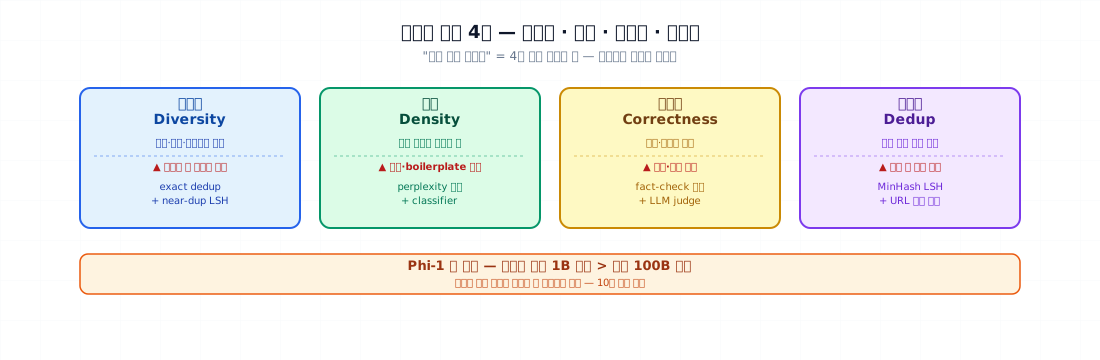
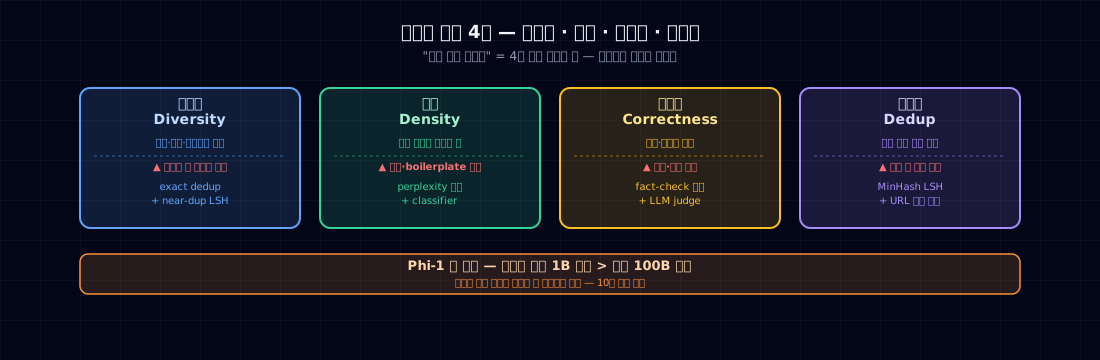
Good training data scores well on four axes:
| Axis | What it means | What breaks without it |
|---|---|---|
| Diversity | Wide vocabulary, varied structure and style | Model learns only one pattern |
| Density | High information per token | Wasted compute on ads and boilerplate |
| Correctness | Factually and grammatically accurate | Hallucinations and errors get trained in |
| Deduplication | No repeated content | Model memorizes instead of generalizing |
"Quality" means all four axes clear the bar. Drop any one of them and things break.
2. Why It Matters — The Phi Proof¶
Phi-1 (2023, 1.3B)¶
"Textbooks Are All You Need"
Prior code models trained on all of GitHub. Phi-1 trained on 6B tokens filtered for "textbook quality" from GitHub code, plus 1B tokens of GPT-3.5-synthesized code.
Results (HumanEval pass@1):
| Model | Parameters | Training tokens | HumanEval |
|---|---|---|---|
| CodeGen-Mono | 16B | 577B | 29.3% |
| Phi-1 | 1.3B | 7B | 50.6% |
12× fewer parameters, 80× fewer tokens — yet 1.7× better capability.
FineWeb-Edu (2024, HuggingFace)¶
15T tokens from Common Crawl → filtered down to 1.3T that scored ≥ 3 on an educational value scale. Same model trained on both datasets:
| Training data | MMLU | ARC-c |
|---|---|---|
| FineWeb (unfiltered) | 38.7 | 47.0 |
| FineWeb-Edu | 44.1 | 52.5 |
Cut the data to 1/12 — scores went up.
These two results are the premise of this chapter: data quality beats scale, up to a point.
3. Where It's Used — Four Curation Tools¶
| Tool | What it removes | Cost | Effect |
|---|---|---|---|
| Exact dedup | Identical documents | Very low (hashing) | Typically 5–20% reduction |
| Near-dup (MinHash) | Near-identical documents | Medium | Additional 5–30% |
| Quality classifier | Low-quality content via educational score | Medium (LLM judge) | 50–90% reduction |
| PII masking | Personal information | Low (regex + NER) | Volume unchanged, legally safe |
This book uses small-scale synthetic data (5K–50K stories), so dedup + quality filter is enough. Large-scale web crawl curation is in Part 8 Ch 29.
4. Minimal Example — Exact Dedup in 30 Seconds¶
Typical result (5,000 synthetic stories):
5% were exact duplicates. The teacher model occasionally produces the same output twice.
5. In Practice — Quality Filter + Near-Dup¶
5.1 LLM Judge for Quality Score¶
- Haiku is sufficient as a judge. 5K × short calls = ~$0.50.
- Score ≥ 3 — the same threshold used by Phi-3 and FineWeb-Edu.
5.2 Near-Dup (MinHash + LSH)¶
- threshold=0.7 — documents with Jaccard similarity ≥ 70% are treated as duplicates. This is the value used by SmolLM2.
- Keep only the first document in each group.
5.3 Token Count Math¶
The token count of your final corpus determines your training token budget.
from tokenizers import Tokenizer
tok = Tokenizer.from_file("tokenizer_ko.json")

total = sum(len(tok.encode(d["text"]).ids) for d in kept)
print(f"  total tokens: {total/1e6:.1f} M")
print(f"  for 10M model (Chinchilla 20x): need 200M")
print(f"  ratio: {total/2e8:.1%}")
Typical result:
5K stories is less than 1% of what a Chinchilla-optimal 10M model needs. You need 50,000–100,000 stories.
The practical alternative: mix TinyStories English (200M+ tokens) with your Korean synthetic data to reach 200M total — the model trains on both languages.
6. Common Failure Modes¶
1. Filter threshold too strict — Requiring score ≥ 4 discards 90% of your data. Diversity collapses. Score ≥ 3 is usually the right balance.
2. Judge model self-bias — When Claude scores Claude-generated data, it tends to rate its own style more favorably. If possible, use a different model as judge (Phi, GPT, etc.).
3. Near-dup threshold too high — At 0.9, almost nothing gets removed. 0.7–0.8 is the standard used by SmolLM2 and FineWeb.
4. Zero human review — Relying entirely on an LLM judge misses subtle hallucinations and cultural errors. Read at least 100 examples yourself (the mini-IAA from Ch 29).
5. Not doing token count math after filtering — 5K stories = 1.4M tokens. 10M model Chinchilla 20× = 200M. That's a 140× gap. Training without enough data may produce meaningless results.
6. Evaluation data leaks into training — Using the same characters in synthesis for both train and eval creates overlap. Separate seeds + hash-check the eval set against training after synthesis.
7. Ignoring the license chain — Teacher API ToS + source dataset license must both pass before you can decide your model's license. (Ch 29)
7. Operational Checklist¶
Final training corpus gate:
- Exact dedup (md5)
- Near-dup (MinHash, threshold 0.7)
- Quality filter (LLM judge, threshold ≥ 3)
- PII masking (Ch 29)
- Validation split (1–2%, hash verified)
- Token count math — Chinchilla or intentional over-training
- License resolved (Teacher API + source datasets + your model)
- Human review: 100 examples
- Corpus metadata recorded (sources, synthesis date, filter version, hash)
8. Exercises¶
- Apply the §4 exact dedup to 5K stories you synthesized yourself. What's the removal rate (%)?
- Run the §5.1 judge with both Haiku and Sonnet on the same stories. Compare scores — what's the mean difference and correlation coefficient?
- Download 1,000 Wikipedia paragraphs and apply the §5.2 near-dup at thresholds 0.5, 0.7, and 0.9. What's the removal rate at each?
- For this book's 10M model, plan a 50% English TinyStories + 50% Korean synthetic mix to total 200M tokens. How many stories of each language does that require?
- (Think about it) "Quality beats size" has an upper limit. Even perfectly curated 1M tokens can't train a 70B model well. Where does quality stop being the bottleneck?
Part 2 Wrap-Up¶
| Chapter | What it covers |
|---|---|
| Ch 5 | TinyStories · the synthetic data era |
| Ch 6 | Training a BPE tokenizer from scratch |
| Ch 7 | Data quality beats size — dedup, filtering, and licensing |
Next up: Part 4 Training on a Laptop. You've seen the transformer code in Part 3, now it's time to train.
References¶
- Gunasekar et al. (2023). Textbooks Are All You Need. (Phi-1) arXiv:2306.11644
- Penedo et al. (2024). FineWeb-Edu — HuggingFace blog & dataset card
- Lee et al. (2022). Deduplicating Training Data Makes Language Models Better. arXiv:2107.06499
- HuggingFace SmolLM2 blog — dedup threshold 0.7 decision
datasketchMinHash LSH library docs