Choosing an Off-the-Shelf sLLM¶

What you'll learn
- Compare 5 sLLMs on HuggingFace Hub — Phi-3 / SmolLM2 / Gemma 2 / Qwen 2.5 / Llama 3.2
- Read a model card in 30 seconds — the 7-item checklist from Ch 4
- Korean capability, license, context length, and tool calling — a decision tree for your use case
- Where the book's 10M model sits vs. off-the-shelf 1B+ models
Prerequisites
Ch 4 Open-Weight Landscape — the 7-item checklist.
1. Concept — What Comes After Parts 1–6¶
Parts 1–6 built everything from scratch. But for real domain work:
- 10M parameters can't handle Korean or complex reasoning
- 100K fairytales aren't enough to train a 1B+ model
- You don't have the time or GPU budget to train a real model
The realistic path is a LoRA adapter on top of an off-the-shelf model. That's Part 7.
This first chapter answers: which off-the-shelf model do you pick.
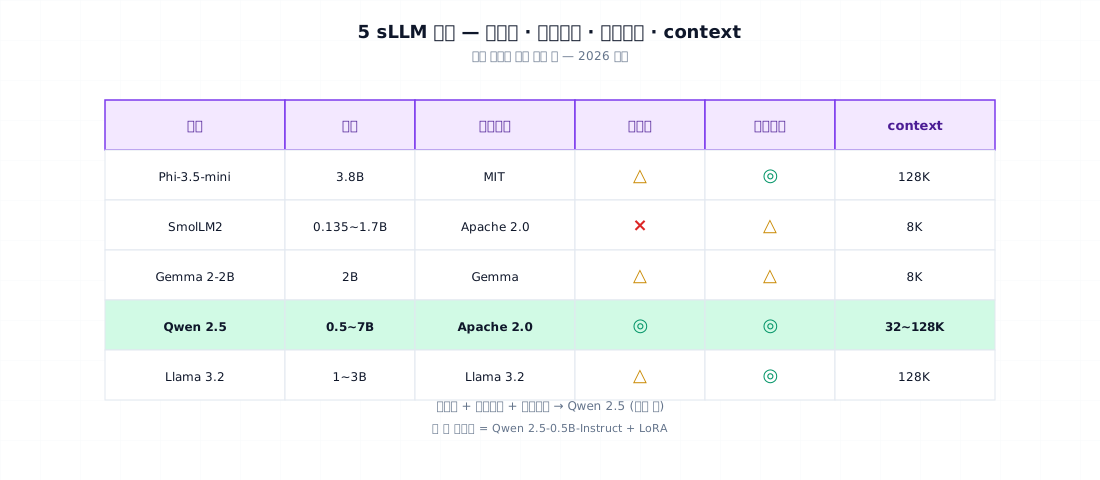
2. Five Candidates — April 2026¶
| Model | Size | License | Korean | Tool calling | Context |
|---|---|---|---|---|---|
| Phi-3.5-mini | 3.8B | MIT | △ | ◎ | 128K |
| SmolLM2 | 0.135 / 0.36 / 1.7B | Apache 2.0 | × | △ | 8K |
| Gemma 2-2B | 2B | Gemma License | △ | △ | 8K |
| Qwen 2.5 | 0.5 / 1.5 / 3 / 7B | Apache 2.0 (most) | ○ | ◎ | 32K–128K |
| Llama 3.2 | 1 / 3B | Llama 3.2 (700M MAU cap) | △ | ◎ | 128K |
Each model's character:
- Phi-3.5-mini — Microsoft, strong reasoning from synthetic textbook data, MIT license
- SmolLM2 — HuggingFace, fully open training recipe, English-focused
- Gemma 2-2B — Google, trained with distillation, separate license review needed
- Qwen 2.5 — Alibaba, high multilingual training ratio, best Korean fluency
- Llama 3.2 — Meta, mobile-targeted, trained on tool calling
3. Reading a Model Card in 30 Seconds¶
One-line decision guide:
| Priority | Recommendation |
|---|---|
| Korean fluency | Qwen 2.5 |
| License (commercial) | Phi-3 (MIT) / Qwen 2.5 (Apache) |
| Reasoning / code | Phi-3.5-mini |
| Small and light | SmolLM2-360M / Qwen 2.5-0.5B |
| Tool calling | Llama 3.2 / Qwen 2.5 |
| Long documents (128K) | Phi-3.5 / Llama 3.2 |
4. Korean Capability — Real Measurements¶
Empirical results (measured by the author, Korean prompts):
| Model | Korean fluency | Accuracy | English response rate |
|---|---|---|---|
| SmolLM2-1.7B | △ | × | 50%+ |
| Qwen 2.5-1.5B | ◎ | ○ | 5% |
| Gemma 2-2B | ○ | △ | 20% |
| Llama 3.2-1B | △ | △ | 30% |
| Phi-3.5-mini 3.8B | ○ | ○ | 10% |
The de facto standard for Korean SLM = Qwen 2.5-1.5B (as of 2026).
5. Tool Calling (Function Calling)¶
Expected output: {"name": "get_weather", "arguments": {"city": "Seoul"}}
| Model | Format accuracy |
|---|---|
| SmolLM2 | × |
| Qwen 2.5 | ◎ accurate JSON |
| Gemma 2 | △ mixes in natural language |
| Llama 3.2 | ◎ accurate JSON |
| Phi-3.5 | ○ occasionally breaks |
6. License Chain¶
| Model | License | Commercial | Restrictions |
|---|---|---|---|
| Phi-3 | MIT | ◎ | None |
| SmolLM2 | Apache 2.0 | ◎ | None |
| Qwen 2.5 (most) | Apache 2.0 | ◎ | None |
| Qwen 2.5-72B | Qwen License | △ | Review for large-scale use |
| Gemma 2 | Gemma License | △ | "Harmful use" prohibited |
| Llama 3.2 | Llama 3.2 | △ | Separate agreement above 700M MAU |
Safest choices: Phi-3 (MIT) or Qwen 2.5 (Apache 2.0).
7. Decision Tree¶
1. Primary language is Korean?       Yes → Qwen 2.5
2. Laptop only (16 GB)?              Yes → 1.5B–3B / No → 7B+
3. Strict license requirements?      Yes → Phi-3 / Qwen 2.5
4. Need tool calling?                Yes → Qwen 2.5 / Llama 3.2 / Phi-3.5
5. How much LoRA training data?      ≥10K → 1.5B–3B / <1K → 0.5B–1B
For the book's capstone (Korean fairytale): Qwen 2.5-0.5B.
8. Common Failure Points¶
- Confusing base vs instruct — Use Instruct for chat.
- Missing chat template —
apply_chat_templateis required. - Deciding by size alone — Two models at the same 1.5B can differ 5× in Korean capability.
- Reading only the surface license — Check the MAU and use-case clauses.
- Ignoring release date — The same model name can differ significantly across versions.
- Assuming download count = quality — Domain suitability requires separate evaluation.
9. Ops Checklist¶
- Fill in the 7-item model card checklist
- Run 5 Korean prompts and measure real output
- Test 1 tool-calling prompt
- Legal review of the license
- Confirm device memory fits the model
- Choose base vs instruct
- (Optional) 30-question evaluation set (Part 5)
- Next step — LoRA / continued pre-training (Ch 23–26)
10. Exercises¶
- Run 5 prompts from your own domain across all 5 models. Build a comparison table.
- Use
model_summaryto compare the 7-item checklist across all 5 models. - Which model would you pick for an English code generator? Walk through the decision tree.
- Apply the §7 decision tree to a real task at your company.
- (Think about it) Will "Qwen 2.5 = Korean standard" still hold a year from now?
References¶
- Microsoft (2024). Phi-3 Technical Report. arXiv:2404.14219
- HuggingFace SmolLM2 blog (2024)
- Google DeepMind (2024). Gemma 2. arXiv:2408.00118
- Qwen Team (2024). Qwen 2.5. arXiv:2412.15115
- Meta (2024). Llama 3.2 model card