LoRA and QLoRA Primer

What you'll learn
- The core idea behind LoRA — one page on why it works
- 30 lines with HuggingFace
peft— LoRA SFT on Qwen 2.5-0.5B-Instruct - QLoRA — LoRA on a 4-bit base. One line difference with
bitsandbytes. - Safe defaults: r=16, alpha=32, target=q,v,k,o, lr=1e-4
Prerequisites
Ch 23 Decision Tree, Ch 22 Model Selection, Ch 12 Training Loop.
1. Concept — Why Low-Rank Is Enough
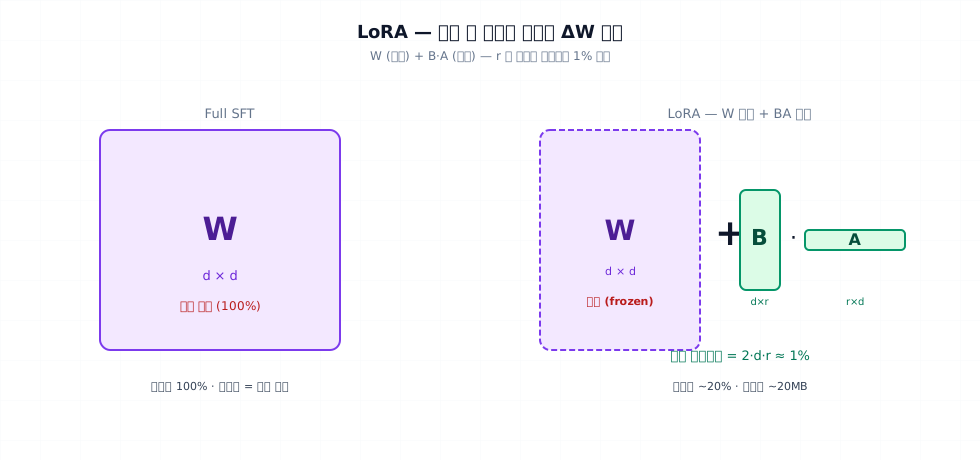
The central hypothesis in LoRA (Hu et al., 2021):
"The weight changes ΔW during fine-tuning can be well approximated by a low-rank matrix."
Standard weight update:
LoRA's approximation:
ΔW is factored into two small matrices. With small r (e.g., 8 or 16), the trainable parameters drop to 0.1–1% of W.
| Base W | Standard SFT params | LoRA r=16 params |
|---|---|---|
| 1B | 1B | 2–4M |
| 7B | 7B | 10–30M |
Why it works: Pre-trained model weights are already rich — domain-specific changes live in a low-dimensional subspace. Empirical and theoretical evidence supports this.
2. Why Use LoRA
| Aspect | LoRA | Full SFT |
|---|---|---|
| Memory | 1/5 to 1/10 | 100% |
| Training time | 1/2 | 1× |
| Adapter size | 10–100 MB | 1–14 GB |
| Domain adaptation | nearly equivalent | slight edge |
| Base license dependency | separable | tied |
Adapter separation is the big advantage — base model (Apache 2.0) + your adapter (your license) can coexist.
3. LoRA SFT in 30 Lines with peft
- r=16, alpha=32 — Hu et al. recommendation + Qwen LoRA guide standard. alpha/r = 2:1.
get_peft_model— freezes base weights, makes only the adapter trainable.- Chat template — Qwen 2.5 format. Automatically wraps in
<|im_start|>user...<|im_end|>. - Only the adapter is saved — about 20 MB (vs 1 GB for the base).
4. QLoRA — 4-bit Base, 1/4 the Memory
One line difference: add quantization_config. The base loads in 4-bit, cutting memory to 1/4.
| Base model | LoRA memory | QLoRA memory |
|---|---|---|
| 0.5B | 2.5 GB | 1 GB |
| 1.5B | 6 GB | 2 GB |
| 7B | 25 GB | 8 GB ← fits on T4 |
| 13B | 45 GB | 14 GB ← fits on T4 |
T4 + QLoRA gets you 7B or 13B training. Before QLoRA, a single A100 was the minimum.
5. Hyperparameter Defaults
| Setting | Value | Notes |
|---|---|---|
r |
8 / 16 / 32 | Start with 16. Increase for more data. |
lora_alpha |
16 / 32 / 64 | Usually 2× r |
lora_dropout |
0.05 / 0.1 | Use 0.1 for small datasets |
target_modules |
q_proj, v_proj only (minimal) ~ all linear (max) |
q,k,v,o is the balanced choice |
lr |
1e-4 to 5e-4 | Higher than base LR (adapter-only training) |
epochs |
1–5 | ≤10K samples: 3; >10K: 1 |
warmup |
5–10% | Standard |
Intuition for choosing r
- r=4: very light. Simple domain shifts (e.g., tone adjustment).
- r=16: standard. General domain SFT.
- r=64+: large-scale change. Mimics continued pre-training.
Choosing target_modules
| Option | Trainable params | Effect |
|---|---|---|
q_proj, v_proj |
0.5% | LoRA paper standard, lightweight |
q_proj, k_proj, v_proj, o_proj |
1.0% | Recommended |
| all linear (including FFN) | 2–3% | Maximum effect, slower |
6. After Training — Merge or Keep Separate
| Approach | Advantage | Disadvantage |
|---|---|---|
| Separate | Swap adapters easily, smaller disk footprint | Tiny overhead from LoRA application at inference |
| Merged | Standard model, easy GGUF conversion | Can't swap adapters, base model size |
Capstone: merge and convert to GGUF (Ch 20).
7. Common Failure Points
1. r too large — r=128+ makes the adapter behave like a sub-model. Overfitting + memory. Start at 16.
2. Wrong target_modules — Only targeting q_proj changes attention only, FFN stays untrained. q,k,v,o is the balanced choice.
3. Learning rate too small — Using the base model's lr of 6e-4 as-is means no learning. LoRA lr should be 1e-4 or higher.
4. Missing chat template — Training on instruction pairs as plain text breaks the format. apply_chat_template is required.
5. Missing EOS token — Without EOS at the end of the assistant turn, training learns to never stop. The tokenizer usually handles this automatically, but verify.
6. Dtype conflict in QLoRA + gradient accumulation — Make sure bnb_4bit_compute_dtype matches args.bf16.
7. No evaluation after training — Whether the adapter actually learned only shows up on an eval set. Compare PPL before and after training.
8. Too many epochs — 5+ epochs on a small dataset = overfitting. Usually start with 1–3.
8. Ops Checklist
LoRA training gate:
- Choose base model (Ch 22)
- Verify r / alpha / target_modules / lr defaults
- Data pairs in correct format + chat template applied
-
print_trainable_parametersshows 0.5–3% - Measure base PPL before training
- Train (1–3 epochs)
- Compare PPL and generation samples after training
- Decide: separate adapter vs merge
- (Next) Update model card 7-item checklist from Ch 22
9. Exercises
- Run LoRA on SmolLM2-135M with 100 pairs. How much does PPL change?
- Train with r=4 / 16 / 64 on the same data. Compare training loss, time, and adapter size.
- Compare
target_modules=["q_proj","v_proj"]vs["q_proj","k_proj","v_proj","o_proj"]. - Compare training speed and final loss between QLoRA (nf4) and standard LoRA (bf16).
- (Think about it) What kind of domain would break the "low-rank is sufficient" hypothesis? Is there a task where r=64 still isn't enough?
References
- Hu et al. (2021). LoRA: Low-Rank Adaptation of Large Language Models. arXiv:2106.09685
- Dettmers et al. (2023). QLoRA: Efficient Finetuning of Quantized LLMs. arXiv:2305.14314
- HuggingFace
peftdocs —LoraConfigdefaults - HuggingFace
bitsandbytes— NF4 quantization