Curriculum
AI Assistant Engineering — building, evaluating, and operating an AI assistant that reasons, calls tools, and improves itself. From beginner to enterprise production.
What this book stitches together
Stanford CME 295 (LLM theory) + Stanford CS329A (Self-Improving Agents research frontier) + Anthropic / OpenAI / LangGraph engineering guides — woven into one reading order. Each chapter ends with primary-source links. This is not a recap; it's the navigation.
1. Roadmap
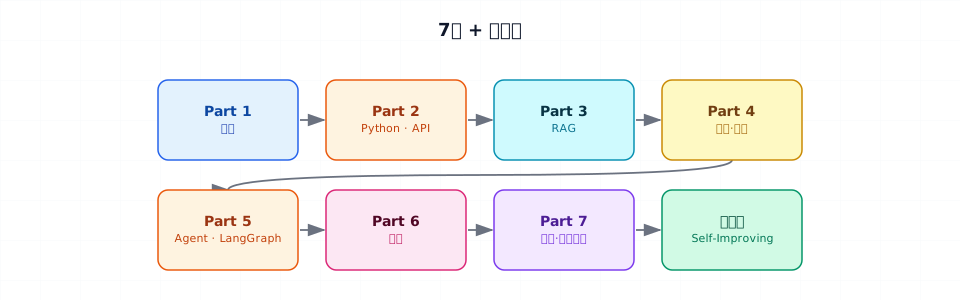
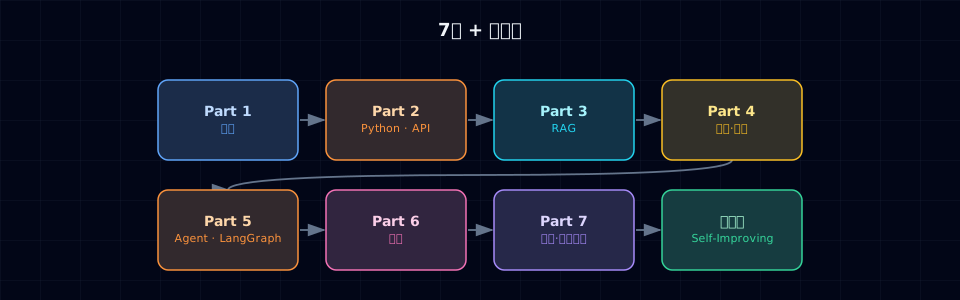
Why evaluation comes before agents
Part 4 (Evaluation) is placed before Part 5 (Agents) on purpose. It tracks Anthropic's recommendation: "start with simple prompts, optimize them with evaluation, and only escalate to agents when simpler solutions fall short."
2. Full table of contents (34 chapters)
Part 1 — Foundations (3 chapters)
| # | Chapter | Core | Reference |
|---|---|---|---|
| 1 | Why models | Rules vs. models. OpenAI's 3-criteria test (complex decisions, brittle rules, unstructured data) | OpenAI Practical Guide |
| 2 | What is an LLM | Tokens, context, next-token prediction, hallucinations | CME 295 Lec 1–3 |
| 3 | Assistant system overview | Input → understand → retrieve → generate → verify → store → monitor → human handoff | — |
Deliverable: glossary · code-vs-model decision table · assistant block diagram
Part 2 — Python & API (5 chapters)
| # | Chapter | Core |
|---|---|---|
| 4 | Getting started with the API | Basic calls, system/user, error handling, retries |
| 5 | Prompts + CoT basics | Roles, few-shot, Chain-of-Thought, "I don't know" |
| 6 | Structured output | JSON Schema · Pydantic · validation · fallback |
| 7 | Streaming & UX | Token streams · partial render · cancel · timeout |
| 8 | Tool Calling basics | Function calling · param generation · safe execution |
Deliverable: Python sample collection · structured-output PoC · first tool-calling example
Part 3 — RAG (6 chapters)
| # | Chapter | Core |
|---|---|---|
| 9 | Why RAG | Freshness · grounding · how it differs from fine-tuning |
| 10 | Embeddings & vector search | Cosine · MMR · vector DB role |
| 11 | RAG pipeline | Ingest · chunk · embed · retrieve · generate · cite |
| 12 | Retrieval quality | Chunk size · top-k · metadata filter · hybrid (BM25 + dense) · reranking |
| 13 | Advanced RAG | HyDE · Self-RAG · GraphRAG · Agentic RAG |
| 14 | LangChain + multimodal RAG | Retriever · chain · prompt template. PDF layout & vision embeddings |
Deliverable: document QA RAG PoC · retrieval-failure analysis · pipeline diagram
Part 4 — Evaluation, Reasoning, Debugging (5 chapters)
| # | Chapter | Core |
|---|---|---|
| 15 | What to evaluate | Retrieval · generation · end-to-end · offline vs online |
| 16 | Building an eval set | Gold set · edge cases · coverage · classification |
| 17 | LLM-as-a-Judge | Judge model design · biases and calibration · human calibration |
| 18 | Reasoning quality | CoT in depth · Self-Consistency · Best-of-N · Verifier models |
| 19 | Failure analysis | Separating prompt / retrieval / data / ranking / generation / tool failures |
Deliverable: eval criteria doc · eval-set draft · failure-analysis report
Part 5 — Agents & LangGraph (6 chapters)
| # | Chapter | Core |
|---|---|---|
| 20 | What is an agent | Model · Tool · Instruction (OpenAI's three pieces). LLM app vs agent |
| 21 | Agent patterns | Anthropic's 5 patterns (chaining, routing, parallelization, orchestrator-workers, evaluator-optimizer) + OpenAI's 2 patterns (manager, decentralized) |
| 22 | Tool Use in practice | Data · Action · Orchestration tools · ACI (Agent-Computer Interface) design · approval gates |
| 23 | LangGraph — state graphs | StateGraph · node · edge · conditional edge · reducer · checkpointer · interrupt |
| 24 | Agent memory | Thread-scoped vs cross-thread store · MemGPT · episodic · KV cache |
| 25 | Multi-agent | Planner/executor · researcher/writer · verifier/responder · the cost of over-decomposition |
Deliverable: tool-using assistant PoC · LangGraph flow diagram · agent failure scenarios
Part 6 — Production (5 chapters)
| # | Chapter | Core |
|---|---|---|
| 26 | Production architecture | Request flow · model/retrieval split · session/memory · sync/async · rate limits |
| 27 | Observability | Logging · tracing · prompt/dataset versioning · latency/cost/quality metrics · LangSmith / Langfuse |
| 28 | Seven guardrails | Relevance · safety · PII · moderation · tool · rules-based · output validation (OpenAI's table) |
| 29 | Human-in-the-loop | Failure thresholds · high-risk actions · escalation · audit logs |
| 30 | Cost & latency | Prompt caching · model routing (Haiku ↔ Sonnet ↔ Opus) · Batch API · context compression |
Deliverable: production architecture doc · observability metric table · safety guide · cost simulator
Part 7 — Models & Fine-tuning (4 chapters)
| # | Chapter | Core |
|---|---|---|
| 31 | Model architecture | Transformer · attention · instruction tuning · base vs chat · open vs hosted |
| 32 | When to fine-tune | Prompt / RAG / structured output come first. Data quantity and quality requirements |
| 33 | LoRA / QLoRA in practice | PEFT · QLoRA · data format · training loop |
| 34 | Small models, distillation, DPO | Latency / cost · distillation · DPO (in the SFT → DPO → RLHF context) |
Deliverable: fine-tuning needs assessment · Colab notebook · small-model deployment ideas
Capstone — Self-Improving Assistant
User feedback logs → automatic failure classification → convert to DPO data → weekly retraining loop. A miniature of the CS329A final project.
Deliverables: problem statement · architecture · data composition · Prompt/RAG/Agent strategy · evaluation results · failure analysis · ops considerations · self-improvement loop design
3. Reference map
- CS329A — Self-Improving AI Agents (Stanford) — agent research frontier
- CME 295 — Transformers & LLMs (Stanford) — theoretical backbone
- CS329T — Building and Evaluating Agentic Systems (Stanford) — project-based eval discipline
- Anthropic Building Effective Agents — 5 patterns
- OpenAI A Practical Guide to Building Agents (PDF) — 3 components, 7 guardrails
- LangGraph official docs — StateGraph · checkpointer · memory
- Claude Cookbook · OpenAI Cookbook · LangSmith / Langfuse tutorials
- RAG: Self-RAG · HyDE · GraphRAG
- Reasoning: Chain-of-Thought · Self-Consistency · Tree of Thoughts · Let's Verify Step by Step · Archon
- Alignment: InstructGPT (RLHF) · DPO · Constitutional AI
- Agents: ReAct · Reflexion · Voyager · SWE-agent · MemGPT · CodeMonkeys
- Efficient FT: LoRA · QLoRA
Primary-source first
This book doesn't paraphrase summaries. Each chapter ends with primary-source links — the book is "in what order, and how to read" — the navigation, not the destination.
4. Stanford course mapping
| CME 295 | Our chapter |
|---|---|
| Lec 1–3 (Transformer · LLM) | Part 1 Ch 2, Part 7 Ch 31 |
| Lec 3 (prompting / ICL) | Part 2 Ch 5 |
| Lec 4 (training, quantization, LoRA) | Part 7 Ch 33 |
| Lec 5 (tuning, RLHF, DPO) | Part 7 Ch 34 |
| Lec 6 (reasoning) | Part 4 Ch 18 |
| Lec 7 (RAG, function calling, ReAct) | Part 3 · Part 5 |
| Lec 8 (LLM-as-a-Judge) | Part 4 Ch 17 |
| CS329A | Our chapter |
|---|---|
| Lec 2–3 (test-time compute, verification) | Part 4 Ch 18 |
| Lec 4–5 (ReAct, multi-step) | Part 5 Ch 20–22 |
| Lec 14 (memory) | Part 5 Ch 24 |
| Lec 13 (SWE agents, CodeMonkeys) | Part 5 Ch 25 + Capstone |
| Lec 17 (long-horizon eval) | Part 4 Ch 15 |
| Lec 7 (self-evolution) · Final project | Capstone |
5. Prerequisites
Python
Functions, classes, async basics. Virtual environments and pip.
Shell
Common commands and environment variables. Skip if you only use Colab.
Reading math
Matrix multiplication, probability, softmax. Part 1 covers what you need.
ML basics
Helpful, not required.
6. What you'll be able to do
A self-check:
- Pick the right tool — code, prompt, RAG, agent, fine-tuning — for any new problem
- Decompose an assistant into input · understand · retrieve · generate · verify · store · monitor · handoff blocks
- Diagnose RAG failures at the prompt / retrieval / data / ranking / generation level
- Map a real problem to Anthropic's 5 patterns and OpenAI's 2 patterns
- Build a multi-step workflow with persistence, interrupts, and memory in LangGraph
- Improve output quality with LLM-as-a-Judge, self-consistency, best-of-N, verifiers
- Apply the seven guardrails as a checklist to a production system
- Cut cost and latency systematically with prompt caching, model routing, batching
- Decide whether fine-tuning is actually needed, and run LoRA/QLoRA on Colab when it is
- Design the feedback log → failure classification → DPO data → retraining self-improvement loop
7. Suggested grading split
- Weekly assignments 30% · hands-on PoCs 30% · mid-course design review 15% · final project 25%
Pass tiers:
- Beginner — can sketch the structure and explain the terms
- Basic — submits RAG · structured output · eval set
- Advanced — agent + ops design + guardrails + improvement report
- Enterprise — finishes the capstone (Self-Improving Assistant)
8. 14-week schedule
| Week | Content |
|---|---|
| 1 | Ch 1–2: why models · LLM basics |
| 2 | Ch 3, 4: assistant structure · first API call |
| 3 | Ch 5, 6: prompts + CoT · structured output |
| 4 | Ch 7, 8: streaming/UX · tool calling |
| 5 | Ch 9, 10: why RAG · embeddings/vector search |
| 6 | Ch 11, 12: pipeline · retrieval quality |
| 7 | Ch 13, 14: Advanced RAG · LangChain + multimodal |
| 8 | Ch 15, 16: eval criteria · eval set |
| 9 | Ch 17, 18: LLM-as-Judge · reasoning quality |
| 10 | Ch 19, 20: failure analysis · what is an agent |
| 11 | Ch 21, 22: agent patterns · tool use |
| 12 | Ch 23, 24: LangGraph · agent memory |
| 13 | Ch 25, 26, 27: multi-agent · production architecture · observability |
| 14 | Ch 28, 29, 30 · Part 7 overview · capstone review |
Part 7 (fine-tuning) is treated as a deep-dive option. The 14-week course covers Parts 1–6; budget 16–18 weeks for all 34 chapters.
9. Priority guide
Must do first — code vs models · LLM basics · structured output · RAG · evaluation · agent patterns · guardrails
Then — agent depth · production architecture · observability · cost/latency · agent memory
Later — fine-tuning · distillation · small models
10. One sentence
Don't go deep into models first. Learn the blocks of a real assistant and design clearly across Prompt / RAG / Agent / Evaluation / Operations / Guardrails.