Ch 12. Improving Retrieval Quality¶

What you'll learn
- Answer quality is 70% retrieval quality — why generation alone can't fix a bad search
- Five types of retrieval failure (recall · precision · ranking · metadata · chunk boundaries)
- BM25 + Dense hybrid search (RRF merging)
- Cross-encoder reranker — boost precision by reordering your top candidates
- MMR (diversity) and metadata filters
- Tradeoffs between chunk size · top-k · rerank cost
Prerequisites
You've run mini_rag.py from Ch 11.
1. Concept — Retrieval sets the ceiling on answers¶
In Ch 11's query pipeline, if you pull back irrelevant documents, the LLM tries to answer from them anyway. You get hallucination or "I don't know."
Generation can't recover from retrieval failure.
So the biggest time sink in Part 3 is improving retrieval quality. This chapter is your toolbox.
2. Five types of retrieval failure¶
| Type | Symptom | Root cause |
|---|---|---|
| Recall miss | Relevant doc never in top-k | Query–doc representation gap · chunk boundary issues |
| Precision miss | Junk docs mixed into top-k | ANN score alone · no diversity |
| Ranking error | Relevant doc exists but ranks low | Dense-only limits (semantic similarity ≠ exact match) |
| Metadata ignored | Stale or private docs in top-k | No updated_at or owner filters |
| Chunk boundary | Answer spans two chunks | Fixed-length chunking |
Each type needs different tools. This chapter maps them.
3. Where it's used¶
The techniques here go into every production RAG:
- FAQ bot using just top-1? → rerank to fix ranking
- Long policy documents? → BM25 hybrid for exact clause matches
- Multilingual docs? → metadata filter by language
- Freshness matters? → updated_at filter
4. Minimal example — Dense vs BM25 vs Hybrid¶
- Whitespace splitting is rough for most languages. Production code needs a proper tokenizer (
kiwi,KoNLPyfor Korean, spaCy for others). - BM25 only scores high if "refund" or "money" appears verbatim. It has no semantic knowledge.
Key observations:
- Dense finds meaning without the exact word ("I want my money back" → refund doc)
- BM25 matches only documents with the word present
- Both miss cases the other catches → combine them (§5.2)
5. Hands-on¶
5.1 Hybrid search pipeline¶
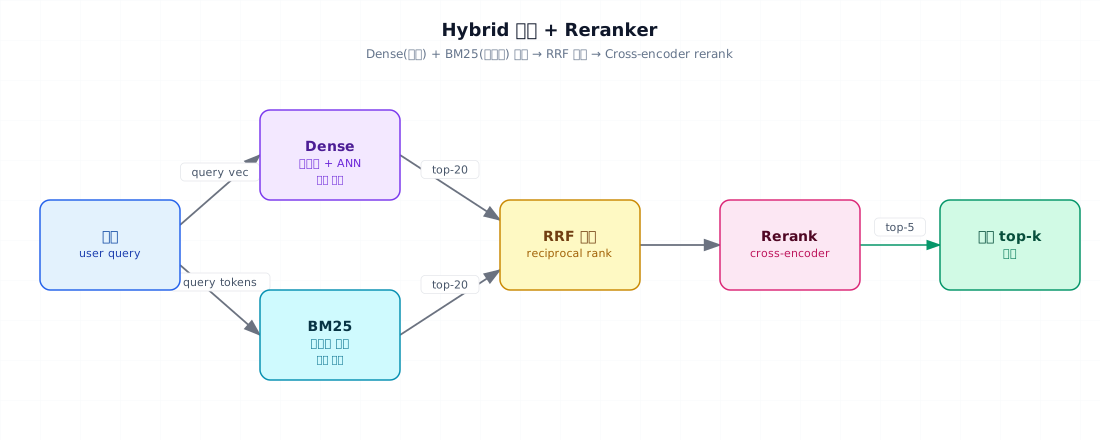
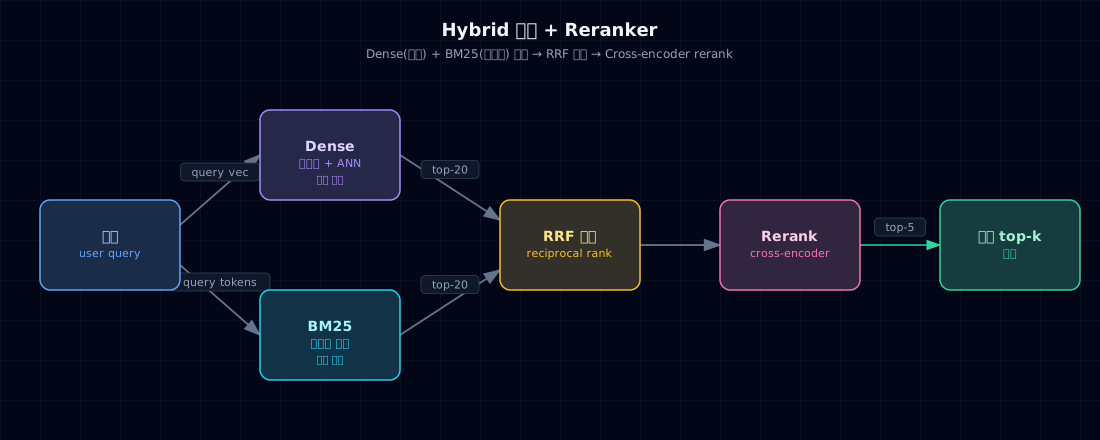
- Dense misses exact terms and numbers that BM25 catches
- BM25 misses synonyms and paraphrases that Dense catches
- Merge their top-N results using RRF (Reciprocal Rank Fusion):
RRF is the standard way to merge two rankers with different score scales. Parameter k=60 works well in most cases.
5.2 Reranker — re-sort your candidates¶
Dense + BM25 might return top-10, but relevant docs could rank low. A cross-encoder reranker fixes that.
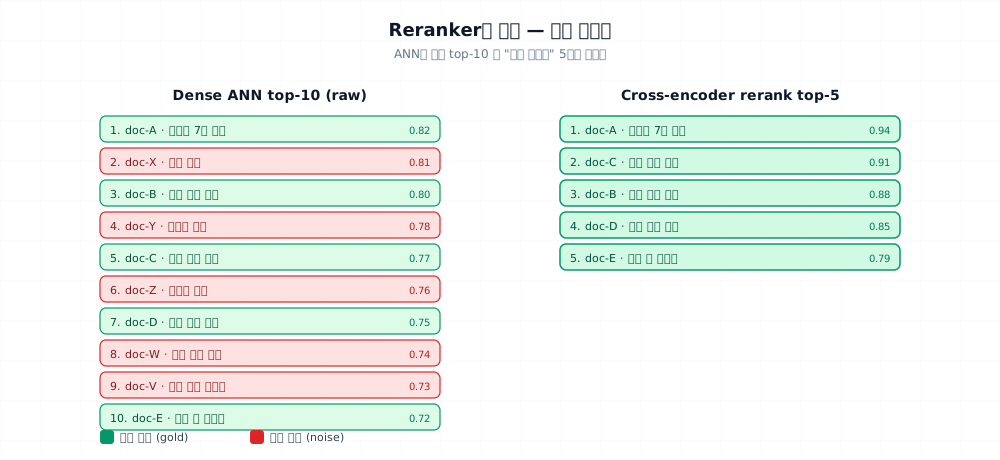
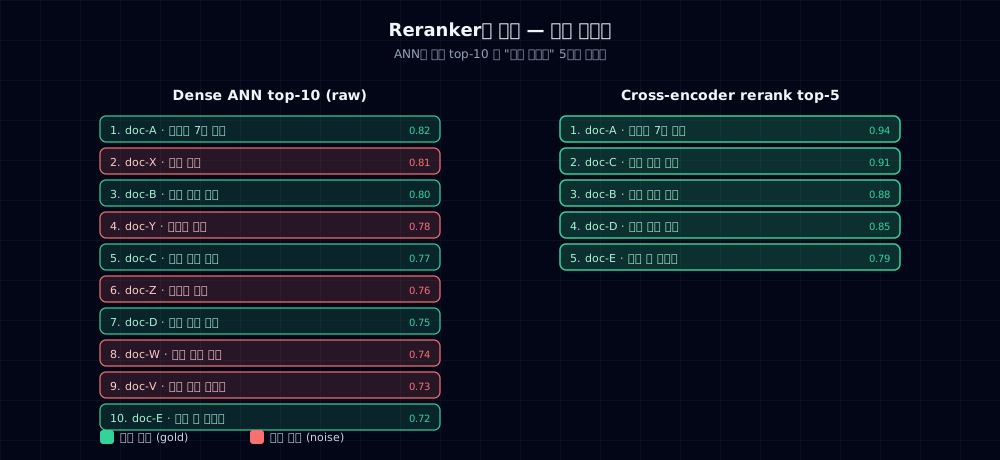
Dense vs cross-encoder:
| Dense (Bi-encoder) | Cross-encoder (Reranker) | |
|---|---|---|
| Method | Embed query and doc separately, then score with dot product | Feed query + doc together, output relevance |
| Accuracy | Medium | High |
| Speed | Very fast (millions of docs) | Slower (practically top-50 max) |
| Role | Recall (cast wide) | Precision (rank tight) |
In practice: Dense/BM25 gets you top-20–50, then cross-encoder re-sorts just the top 5–10.
Alternatives:
- Voyage
rerank-2— multilingual · higher accuracy - Cohere
rerank-v3— established standard - BGE Reranker (open-source) — runs on your GPU
- Custom cross-encoder (HuggingFace
sentence-transformers/ms-marco-*)
5.3 MMR — diversity¶
If top-5 is all near-duplicates, information density plummets. MMR (Maximal Marginal Relevance) balances relevance and diversity:
Built into Chroma and LangChain:
results = col.query(
    query_embeddings=[q_emb],
    n_results=10,
    # LangChain: search_type="mmr", search_kwargs={"lambda_mult": 0.5}
)
With λ=0.5, you balance relevance and diversity equally. Lower it to emphasize diversity when you're getting too many similar chunks.
5.4 Metadata filters¶
Filter before search using where conditions:
# Only recent documents
col.query(
    query_embeddings=[q_emb],
    n_results=10,
    where={"updated_at": {"$gte": "2026-01-01"}},
)

# Only from one team (access control)
col.query(
    query_embeddings=[q_emb],
    n_results=10,
    where={"$and": [{"owner": "finance"}, {"lang": "en"}]},
)
Filter first, then search — you get better latency. Your first line of defense for access control · freshness · language separation.
5.5 Parameter tuning — chunk size · top-k · overlap¶
Set once and forget? No. You'll cycle through failure analysis → adjust repeatedly:
| Parameter | Increase it | Decrease it |
|---|---|---|
| Chunk size ↑ | Preserve context · lower precision · more tokens | Finer detail · lose context · fewer tokens |
| Chunk overlap ↑ | Protect boundaries · redundancy grows | Better index efficiency · boundary cutoff risk |
| Top-k ↑ | Higher recall · more noise · more prompt tokens | Tight results · miss relevant docs |
Starting point (English and mixed-language):
chunk_size=512,overlap=64,top-k=10→ rerank down totop-5
5.6 Collect and classify retrieval failures¶
Weekly review: Take 20 cases with 👎 feedback and bucket them into the 5 failure types from §2. Fix the most common first (that feeds into Ch 13 Advanced RAG).
6. Common breaking points¶
Mistake 1: Shrink chunks blindly
Recall goes up, but context gets cut and answer quality can drop. Tiny chunks in your prompt lose their relationship to each other.
Fix: Start with chunk_size=512 · overlap=64. Adjust only after failure analysis.
Mistake 2: Rerank top-500
Cross-encoders are slow. Reranking 500 docs pushes p95 latency to 5–10 seconds.
Fix: Dense/BM25 gets you top-20–50 first, then rerank only that.
Mistake 3: Expect fresh docs without filters
A question like "What's today's announcement?" returns a 3-year-old doc at rank 1. Semantic similarity doesn't capture recency.
Fix: Use updated_at filter + recency boost (multiply score by time decay).
Mistake 4: Tokenize Korean with just split()
"환불해주세요" becomes one token; BM25 fails to match. Semantically it's there, but no word overlap.
Fix: Use a morphological analyzer (kiwi, KoNLPy) before BM25.
Mistake 5: Don't track reranker cost
Voyage and Cohere rerank APIs cost money and add latency. Costs grow fast with top-k and call volume.
Fix: Log cost and latency per call → monthly budget. Consider switching to local BGE reranker.
7. Production checklist¶
- Weekly review of 5 failure types (at least 20 samples)
- Parameter log — chunk_size, overlap, top-k, rerank top-n
- Dense vs BM25 vs Hybrid A/B test → pick your baseline
- Reranker cost/latency dashboard (price per Voyage/Cohere call)
- Metadata filter required — access control · freshness · language
- Recency boost formula documented (e.g.,
score * exp(-days/30)) - MMR lambda (λ) tuned per use case
- Retrieval failure logs (separate bucket for top-1 score below threshold)
8. Practice problems¶
- Run §4's
dense_vs_bm25.pyon 10 English and 10 non-English sentences, list strengths per type - Compare RRF merge output to each ranker's top-5 — quantify the merge benefit
- Attach Voyage rerank-2 to §5.2, measure precision before/after top-10 → top-5
- Vary chunk_size to 256 · 512 · 1024 on the same query, log precision/recall deltas
- Artificially make old docs rank first, then solve with
updated_atfilter
9. Further reading¶
- BM25 — Robertson & Zaragoza (2009), "The Probabilistic Relevance Framework"
- RRF — Cormack et al. (2009), "Reciprocal Rank Fusion outperforms Condorcet..."
- Voyage rerank-2: docs.voyageai.com/reference/reranker-api — officially recommended by Anthropic
- Cohere Rerank v3: docs.cohere.com/docs/rerank-2
- BGE Reranker: huggingface.co/BAAI/bge-reranker-large
- LangChain Retrievers: python.langchain.com/docs/modules/data_connection/retrievers
- Stanford CME 295 Lec 7 — archived in project
_research/stanford-cme295.md
Next → Ch 13. Advanced RAG
Foundations set. Now HyDE · Self-RAG · GraphRAG · Agentic RAG — production-grade techniques from the papers.