Ch 31. Model Architecture Overview

What you'll learn
- The Transformer block — a simplified dissection: embedding · self-attention · FFN · residual connections
- Next-token prediction as a single training objective
- Three training stages — Pretraining → SFT → RLHF/DPO and what each does
- Base vs. Instruct vs. Chat models — what the names mean
- Where modern variants fit — MoE · RoPE in one sentence each
- Skip the formulas — build intuition first
- Five operational facts that save you from disasters: context window limits · tokenizers · quantization · MoE · model cards
Prerequisites
Part 1–2 basics. Calculus and linear algebra help but aren't required. This chapter's goal is enough intuition to operate models well from the outside, not how to build them.
1. Concept — One Transformer block
Almost every LLM is a variant of the Transformer (2017). Modern models stack N identical blocks (usually 24–80), and each block does exactly two things.
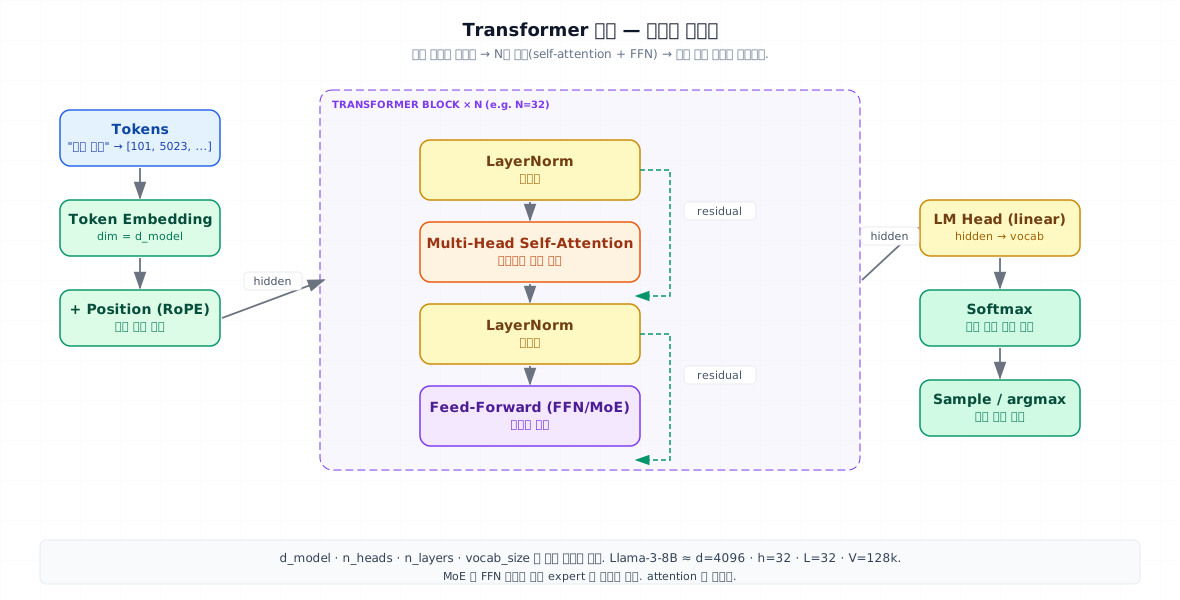
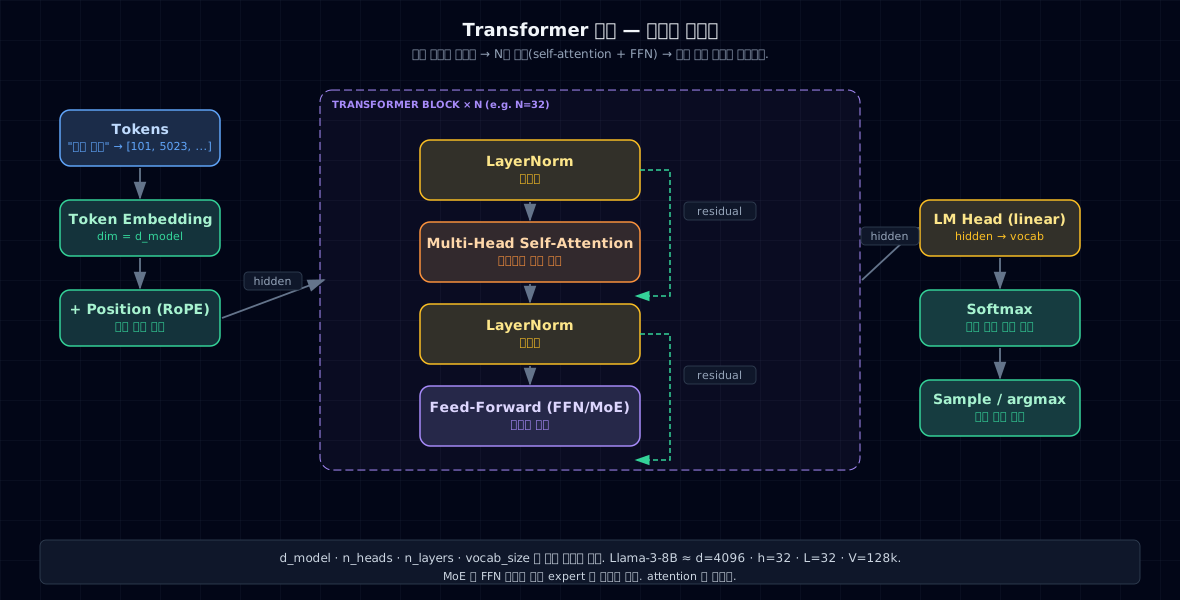
| Stage | What it does | Role |
|---|---|---|
| Tokens | String → integer sequence | "Hello world" → [101, 5023, ...] |
| Token Embedding | Integer → high-dimensional vector (d_model) | Semantic representation |
| Position (RoPE) | Inject position information | Add "word order" |
| Self-Attention × N | Tokens exchange information | Context-dependent representation |
| FFN (Feed-Forward) × N | Nonlinear transform | Expressiveness |
| LM Head + Softmax | hidden → vocab distribution | Probability of next token |
Every LLM's training goal is exactly one thing: predict the probability distribution of the next token. That's it. Repeat "what follows 'hello'?" billions of times, and grammar, factual knowledge, code, reasoning — all emerge as side effects.
Self-Attention in one sentence
"Each token sees every token in the sequence (including itself) and learns how much to attend to each through learned weights."
For the math (Q·K·V · softmax · scale), see the original Attention is All You Need. What matters for operations:
- Attention cost is quadratic in sequence length (O(n²)). Double context → cost and latency roughly ×4 — this is why context compression (Ch 30) exists.
- Multi-head: Run the same attention N times in parallel (h=8–64). Different heads are believed to specialize in different relationships (syntax · co-occurrence · coreference).
FFN — Mixture of Experts variant
Standard FFN: all tokens pass through the same large weight matrix. MoE (Mixtral · DeepSeek · estimated GPT-4) replaces FFN with multiple experts (e.g., 8) and activates only a subset per token (e.g., 2). Total parameters large, but active parameters small — more efficient inference.
Residual + LayerNorm
Residual connections like x + Attn(LN(x)) let deep networks learn. LayerNorm (or RMSNorm) stabilizes numerics.
2. Why this matters — intuition changes how you operate
You can run LLMs without knowing these formulas. But miss these facts and you'll have problems.
| Fact | Operational consequence |
|---|---|
| Attention is O(n²) | Context ×2 → cost and latency ≈ ×4. Infinite context doesn't exist. |
| Models learn at the token level | "Count to 200 characters" is surprisingly weak (BPE tokens ≠ characters). |
| Next-token prediction is the training goal | Models lean toward "plausible answer" over "I don't know" (source of hallucination). |
| Position is only stable within training distribution | Stretch beyond training context and quality drops fast. |
| Tokenizer varies per model | Same Korean sentence → different token counts → different costs. |
These five facts alone speed up your diagnosis in Ch 30 (cost and latency) and Ch 19 (failure analysis) by hours.
3. Where it's used — Three training stages
The same Transformer gets tuned three times before it becomes what you use.
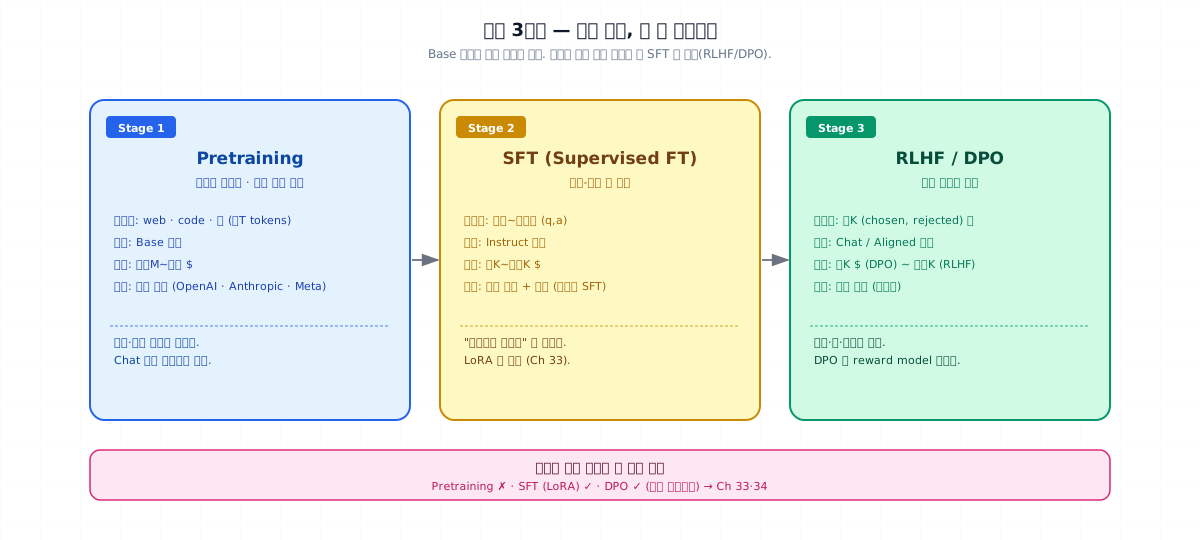
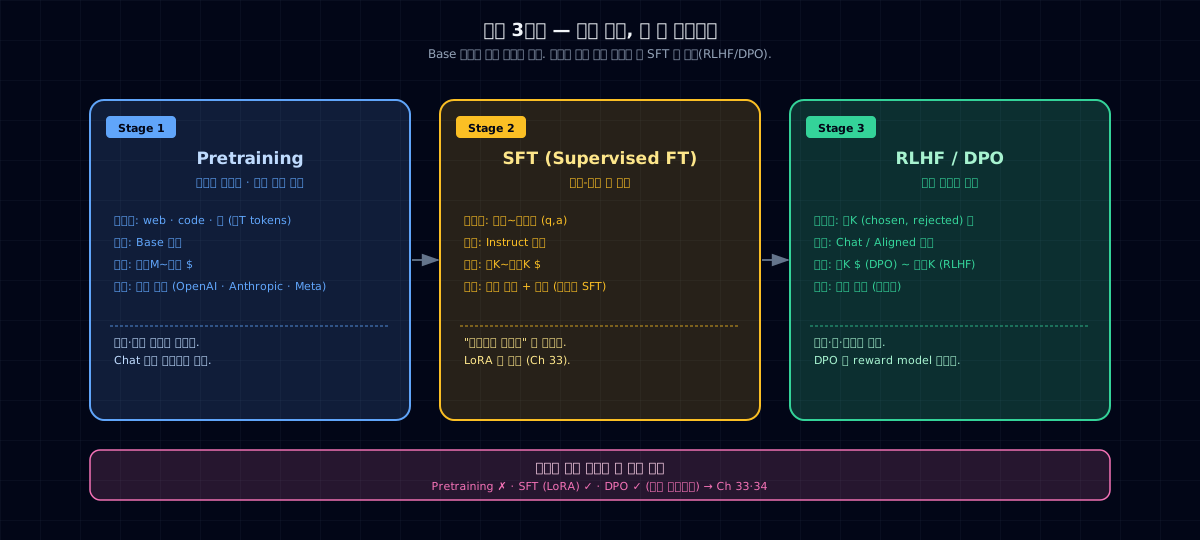
Stage 1 — Pretraining (Base model)
- Data: Web + code + books = trillions of tokens
- Goal: Next-token prediction only
- Result: Base model — continues sentences, but doesn't "take instructions and answer"
- Cost: Tens of millions to hundreds of millions of dollars · thousands of GPUs
- You can't do this. Model companies run it once; you use the result.
Stage 2 — SFT (Supervised Fine-Tuning)
- Data: Human-written (instruction, response) pairs — tens to hundreds of thousands
- Goal: Learn to "take instruction and respond"
- Result: Instruct model (first step of Llama-3-Instruct, Qwen-Chat, etc.)
- Cost: Tens of thousands to hundreds of thousands of dollars
- You can start here (LoRA — Ch 33)
Stage 3 — RLHF / DPO
- Data: Humans annotate (good response, bad response) pairs — thousands to tens of thousands
- Goal: Align on safety · tone · factuality
- Result: Chat model (ChatGPT, Claude, final version of Llama-3-Instruct)
- Two approaches:
- RLHF: Train a reward model → PPO reinforcement learning. Complex · expensive · unstable.
- DPO (2023): No reward model; optimize directly from preference pairs. Much simpler → Ch 34
- You can do this too — DPO is as accessible as SFT.
4. Minimal example — Inference with Hugging Face base model
Llama-3.1-8Bis the base model;Llama-3.1-8B-Instructis the chat model (SFT+DPO). Base doesn't "answer questions" — it just continues text.
Observation: Watch the base model continue plainly instead of responding in answer format. Feel the difference SFT adds.
5. Hands-on — Five operational facts
① Context window — truth vs. advertising
| Model | Advertised context | Effective context |
|---|---|---|
| Claude Opus 4.7 | 1M tokens | Search and summarization OK; deep reasoning safe up to 200k |
| GPT-4 Turbo | 128k | Accuracy drops after ~80k (reported) |
| Llama-3.1-8B | 128k | Without RoPE scaling, trust only up to 8k |
Advertised and effective context differ. Measure with benchmarks like RULER and Needle-in-Haystack.
② Tokenizer — Korean token cost
from transformers import AutoTokenizer
t1 = AutoTokenizer.from_pretrained("gpt2")
t2 = AutoTokenizer.from_pretrained("meta-llama/Llama-3.1-8B")

s = "안녕하세요, 반갑습니다."
print(len(t1.encode(s)), len(t2.encode(s)))   # Example: 27 vs 11
The same Korean text can tokenize very differently across models. Run the actual candidate tokenizer before estimating cost.
③ Quantization — same model, different memory
| Precision | bits/param | 8B model memory | Quality |
|---|---|---|---|
| FP32 | 32 | 32 GB | Baseline |
| BF16 | 16 | 16 GB | Nearly identical |
| INT8 | 8 | 8 GB | Slight loss |
| INT4 (QLoRA bnb) | 4 | 4 GB | Minor loss (usually OK) |
The core trick for running 8B models on consumer GPUs — covered in Ch 33's QLoRA.
④ MoE models in operation
Total 671B parameters (DeepSeek-V3) but only 37B active → inference cost matches smaller models. But memory = total parameters — VRAM is the bottleneck. Hosted APIs are usually smarter.
⑤ Reading a model card
When adopting a new model, check:
- Training data cutoff — does it include our domain's timeframe?
- Context length + safe range (see ①)
- License — commercial use allowed? (Llama 3 yes, some restricted)
- Benchmark scores — trust benchmarks close to your domain only
- Tokenizer + multilingual support
- Safety / refusal policy — might conflict with your guardrails (Ch 28)
6. Common pitfalls
- Diving into formulas. Operators need attention intuition; skip Q·K·V math. Spend that time on context limits · tokenizers · costs.
- Using base models for chat. Base just continues text — won't answer. Use Instruct or Chat variants.
- Assuming advertised = effective context. 1M context doesn't mean use all 1M safely. Measure effective limits with your own domain tasks.
- Treating tokens like characters. "200 characters" varies wildly by model and language. Count with the tokenizer.
- Assuming all models share a tokenizer. SFT data built on one tokenizer but applied to another → training fails or halves efficiency.
- Trusting active parameters for MoE memory. VRAM = total parameters. 671B MoE is never a small model.
- Skipping evaluation after quantization. INT4 "almost identical on average" doesn't mean your domain is average. Always run domain tests after quantizing.
7. Operational checklist
- Record the exact model ID · version · training cutoff you're running
- Measure effective context on your representative task
- Check Korean tokenization efficiency (input to cost model)
- If quantizing, run domain regression tests
- Base / Instruct / Chat distinction is clear
- Review model card license and safety policy (align with Ch 28)
- For MoE models, split VRAM and cost budgets between hosted and self-hosted
8. Exercises & next chapter
- Run the same prompt ("Q: What's the capital of Korea? A:") on Llama-3.1-8B-Base and Llama-3.1-8B-Instruct. Observe the difference in one sentence.
- Pick 100 Korean sentences. Compare token counts across GPT-4o · Claude · Llama-3 · GPT-2. Table the cost differences.
- Starting from "Attention is O(n²)", explain in a paragraph how context compression (Ch 30 ④) reduces cost.
- For your domain, rank the five model card items by priority when adopting a new model.
Next → When to Fine-Tune — so when should you actually tune a model?
References
- Vaswani et al. (2017) Attention is All You Need
- Touvron et al. (2023) Llama: Open and Efficient Foundation Language Models
- Ouyang et al. (2022) Training language models to follow instructions with human feedback (RLHF)
- Rafailov et al. (2023) Direct Preference Optimization (DPO)
- Stanford CME 295 — Transformers and LLMs Lectures 1–4
- Hugging Face — transformers documentation