Capstone — Self-Improving Assistant

What you'll build
- Every piece from Parts 1–7 integrated into one system
- A closed feedback loop where user feedback becomes evaluation data and training data automatically
- An 8-stage pipeline — user → assistant → trace → failure classifier → DPO data → retrain → eval gate → deploy
- 8-week progression guide and a 9-item deliverables checklist
- Five common failure modes (loop doesn't close · eval data leaks · self-reinforcement bias · negative ROI · safety regression)
Prerequisites
You've completed the core chapters in Parts 1–6. Part 7 Ch 32–33 are helpful context; Part 7 Ch 34 (DPO) is optional — you can start at a conceptual level.
1. Concept — Why "self-improving"?
Most LLM products ship and then freeze. The model stays the same, the prompt stays the same, but your users keep changing — and over time, you get more wrong answers.
This capstone's goal: close the loop so the system gets better every week.
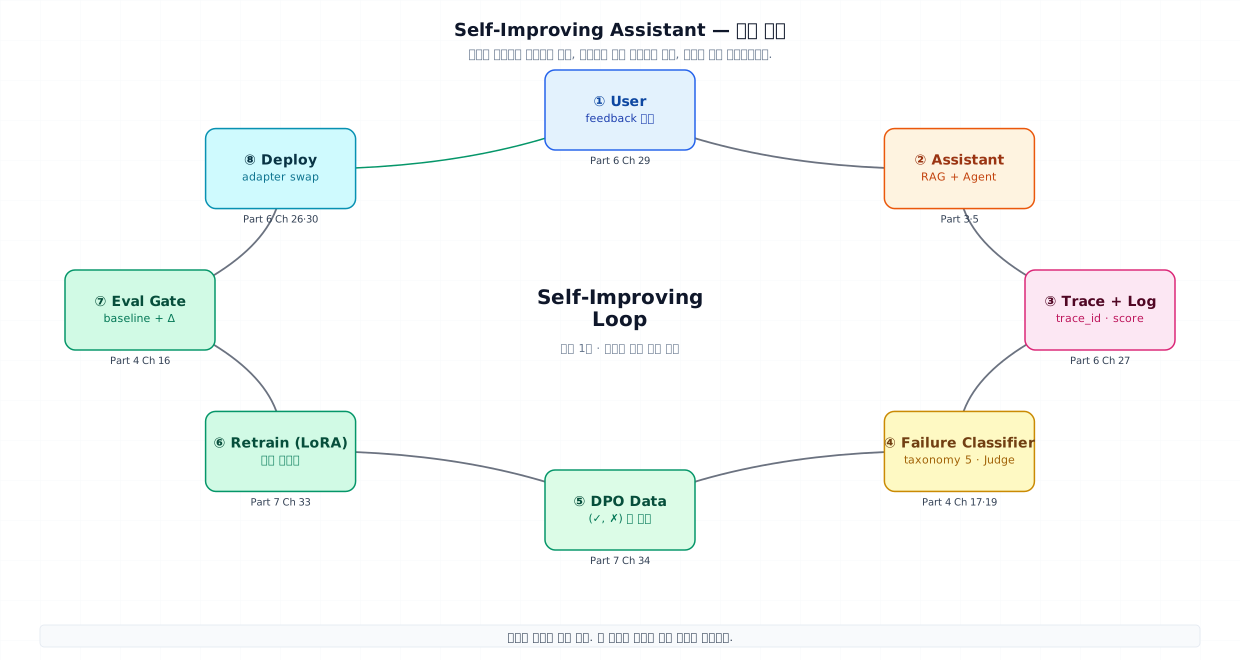
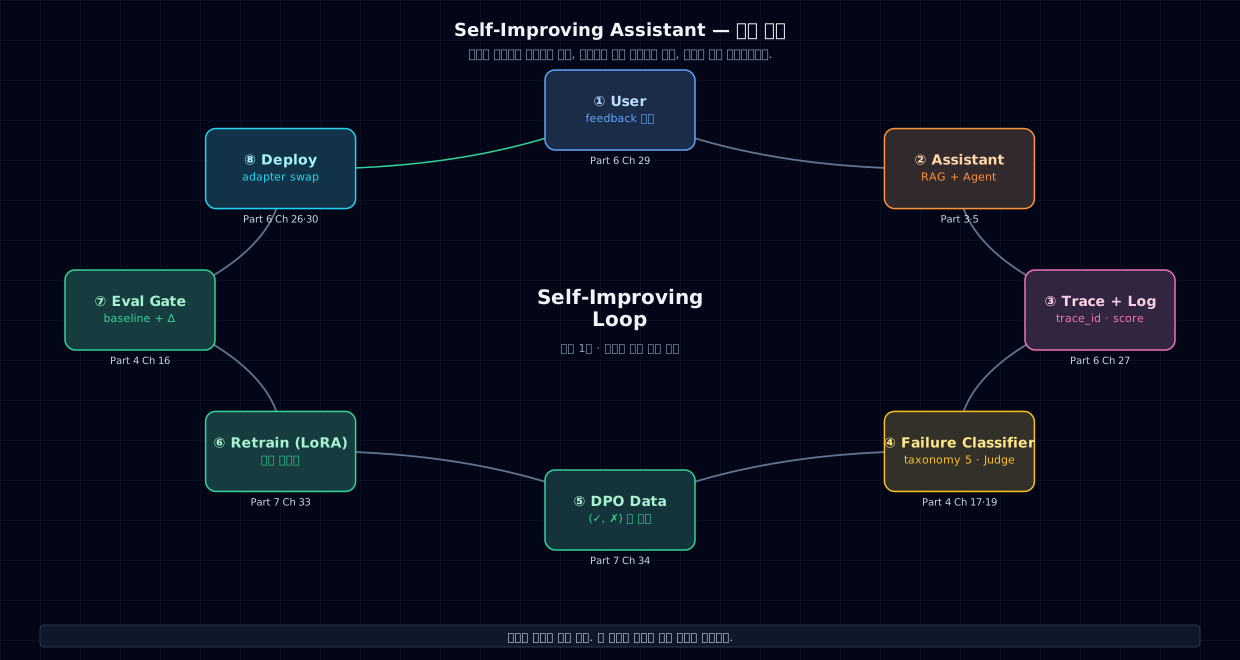
| Stage | What | Source |
|---|---|---|
| ① User | 👍/👎 + free text + auto signals (re-query rate) | Ch 29 |
| ② Assistant | RAG + Agent + guardrails | Parts 3·5 |
| ③ Trace + Log | trace_id · cost · score attached | Ch 27 |
| ④ Failure Classifier | 5-tier taxonomy + Judge score | Ch 17·19 |
| ⑤ DPO Data | (q, ✓, ✗) pairs auto-generated | Ch 34 |
| ⑥ Retrain (LoRA) | Weekly schedule + small adapter | Ch 33 |
| ⑦ Eval Gate | baseline + Δ must pass | Ch 16 |
| ⑧ Deploy | adapter swap + canary | Ch 26·30 |
Skip even one stage and self-improvement stops. The whole system works only if the loop is closed.
2. Why it matters — Three ways static deployments decay
① Distribution drift. The questions users ask shift every week — further from your training data — accuracy drops.
② New facts emerge. Your domain launches products or changes policy, but the RAG corpus lags. Answers go stale.
③ Known failure patterns pile up. The same wrong answer hits the same users week after week. Support inboxes overflow.
With a closed loop, all three show up as automatic signals (Ch 27 metrics) that flow into stages ⑤–⑥ as training data.
3. Where it fits — The integrated architecture
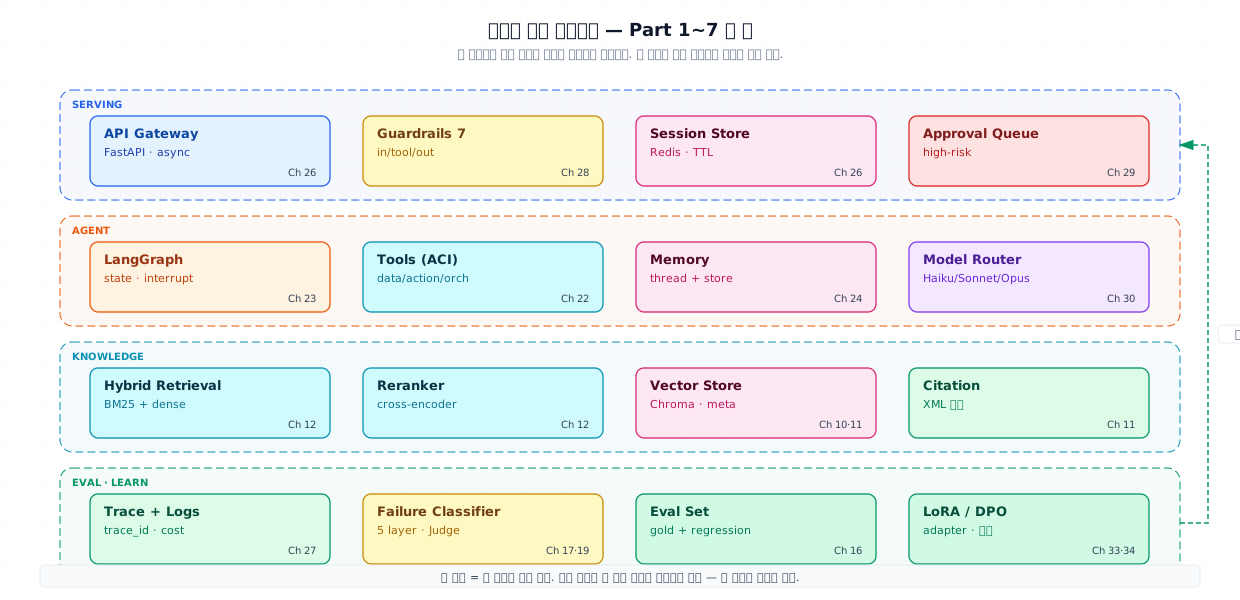
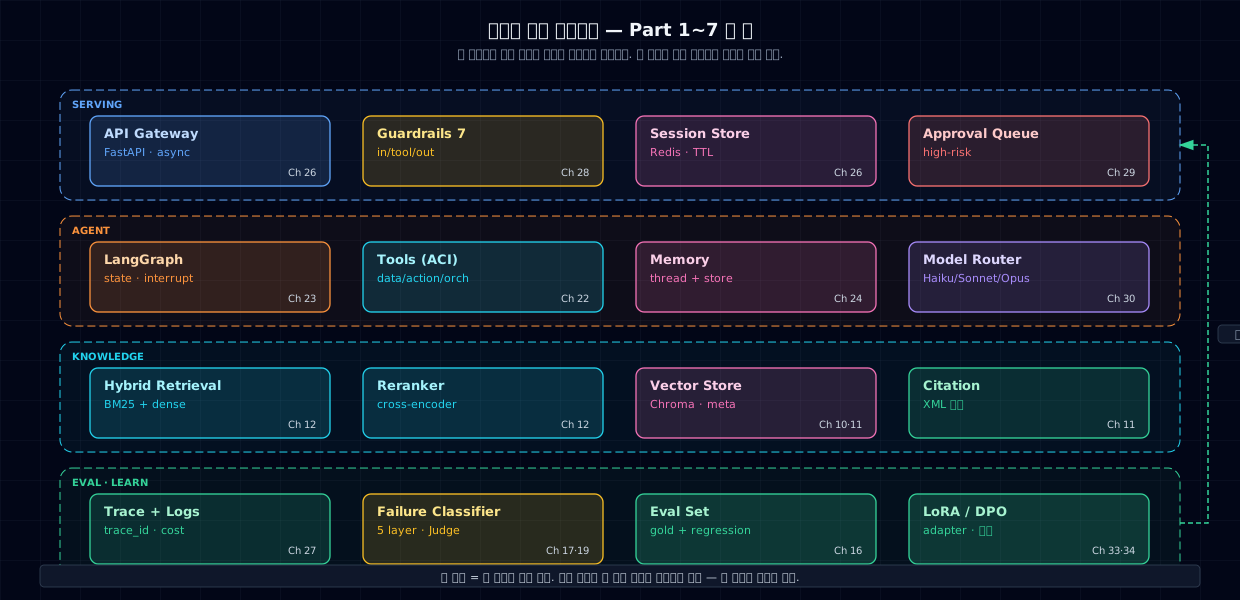
Four layers:
| Layer | Modules | Core chapters |
|---|---|---|
| Serving | API Gateway · Guardrails · Session · Approval Queue | 26 · 28 · 29 |
| Agent | LangGraph · Tools · Memory · Model Router | 22–24 · 30 |
| Knowledge | Hybrid Retrieval · Reranker · Vector · Citation | 10–12 |
| Eval · Learn | Trace · Failure Classifier · Eval Set · LoRA/DPO | 16–19 · 27 · 33–34 |
One module = one chapter. You don't need all of them — pick what fits your domain.
Choose a use case (pick one)
| Use case | Data | Self-improvement signal |
|---|---|---|
| In-house IT helpdesk | Wiki · ticket logs | Ticket reopening rate |
| Meeting note summarizer | Audio · memo | User edit rate |
| Code review helper | git log · PRs | Comment adoption rate |
| FAQ auto-responder | Customer inquiries | Re-query rate / human handoff |
In-house IT with a wiki and ticket system has the richest data. That's the recommended starting point.
4. Minimal example — Week 1 skeleton (200 lines)
- Input guardrails (Ch 28). Hard failures (safety/moderation) run serial; others optimistic parallel.
- RAG hybrid retrieval (Ch 12) + reranker.
- LangGraph state machine (Ch 23). Use interrupt_before for high-risk actions.
- Bind user feedback to trace_id and store — the loop's entry point.
- Weekly cron. Collect failures → build DPO pairs → train → eval gate.
- Generate (q, ✓, ✗) pairs: rejected answer = 👎 case, chosen = better answer from Judge.
- Won't deploy if +3 points aren't gained. This gate stops regression.
5. Hands-on — 8-week progression
| Week | Activity | Deliverable |
|---|---|---|
| 1 | Pick use case · collect data · sketch 8-stage diagram | Problem statement + architecture SVG |
| 2 | RAG pipeline (Ch 11–14) | mini_rag.py + 100 eval examples (Ch 16) |
| 3 | LangGraph Agent + seven guardrails | First working demo |
| 4 | Observability + 5 pilot users | Langfuse dashboard |
| 5 | Feedback endpoint + failure classifier (Ch 19) | 1-week log analysis report |
| 6 | DPO data generation + first LoRA train (Ch 33) | adapter v1 + eval scores |
| 7 | Weekly automation (cron + eval gate) | Auto-deploy workflow |
| 8 | 1 more week + retrospective | Final report |
5 real users for 1 week = typically 200–500 traces. Enough to build 100–300 (✓, ✗) pairs for DPO training.
Evaluation — baseline · post-DPO · regression
| Metric | Measured | Target |
|---|---|---|
| Domain accuracy | 100 hold-out examples (Ch 16) | baseline +3 points |
| Latency p95 | Ch 27 metrics | baseline or lower |
| Cost / request | Ch 27 metrics | baseline ±10% |
| Guardrail trigger | Ch 28 | No regression |
| Regression set | Cases that passed before | 100% preserved |
| User CSAT | 👍 / (👍+👎) | baseline +5% |
All six metrics must pass before you deploy a new adapter. One regression blocks it.
DPO data auto-generation pattern
async def build_dpo_pairs(bad_cases):
    pairs = []
    for case in bad_cases:
        rejected = case["answer"]                       # Answer that got 👎
        # Generate better answer with Judge LLM
        chosen = await call_llm("claude-opus-4-7",
            prompt=f"Answer this question more accurately and politely:\n{case['q']}")
        # Check: does rejected differ meaningfully from chosen?
        if similarity(rejected, chosen) > 0.9:           # Too similar = weak signal
            continue
        pairs.append({
            "prompt": case["q"],
            "chosen": chosen,
            "rejected": rejected,
        })
    return pairs
6. Common pitfalls
- Loop doesn't close. You collect feedback but training is manual → forgotten in a month. Automate the weekly cron + alerts to make it truly self-improving.
- Eval data leaks into training. Eval set gets mixed into training data → great training scores, real regression. Auto-check hashes before training starts.
- Self-reinforcement bias. Generate ✓ using a Judge LLM and you encode the Judge's biases. Spot-check 5% of chosen answers with humans to catch drift.
- Negative ROI. Labeling + GPU + ops costs don't justify the savings. Revisit Ch 32 ROI math every quarter.
- Safety regression. After DPO, rejection policies weaken → jailbreak answers appear. Keep a separate safety regression eval set (Ch 28).
- Adapter accumulation. 52 adapters in a year, can't track which is best. Version everything + auto-rollback policy.
- Assuming 5 users generalize. 5-user patterns ≠ 100-user patterns. Careful canary rollout (10% → 50% → 100%) then expand.
- Ignoring Judge accuracy. If your failure classifier is 60% accurate, 40% of training data is noise. Measure Judge accuracy separately (Ch 17).
7. Operations checklist
- All 8 stages automated (zero manual steps)
- Every trace has trace_id · user_id · model_version · adapter_version
- Training data ↔ eval set contamination detected automatically
- Judge accuracy measured separately (target 80%+)
- 6-metric gate (accuracy · p95 · cost · guardrail · regression · CSAT) enforced
- Safety regression eval set (covers all seven guardrails)
- Adapter versioning + instant rollback possible
- Canary deployment (10% → 50% → 100%) + per-stage alerts
- Weekly metric report (auto-sent)
- 1-year ROI stays positive · reviewed every quarter
8. Deliverables checklist
| # | Item | When |
|---|---|---|
| ① | Problem statement — what assistant · for whom · why | Week 1 |
| ② | Architecture SVG — modules mapped to chapters | Week 1 |
| ③ | Data inventory — RAG corpus · 100+ eval examples | Week 2 |
| ④ | Prompt/RAG/Agent strategy — implementation code per block | Weeks 2–3 |
| ⑤ | Seven guardrails coverage table | Week 3 |
| ⑥ | Evaluation results — baseline vs post-DPO comparison | Week 7 |
| ⑦ | 20+ failure case analysis — taxonomy classified | Week 5 |
| ⑧ | Ops considerations — cost · latency · safety analysis | Weeks 4–6 |
| ⑨ | Self-improving loop design — cadence · triggers · gates · rollback | Week 7 |
Week 8 presentation (30 min): - Demo (5 min, live) - Architecture (5 min) - Evaluation results (10 min, including regression) - Retrospective (10 min — what broke, what's next)
Closing — Where you go from here
Finish this capstone and the next frontier is your domain.
Expansion paths:
- Multi-agent evolution (Ch 25) — one agent runs 24/7, another handles retraining
- Constitutional AI (Ch 34) to lower labeling cost — but keep human review
- Online learning — weekly → daily → real-time (higher risk, higher cost)
- Multi-modal — images, audio, documents (Ch 14)
What this book doesn't cover: - Distributed training (tens to hundreds of GPUs) - Custom pretraining - Agent simulation environments (CS329A territory) - AGI discussions
This book assumes you're an engineer making great use of external models. You've now reached the deepest point possible while calling an outside API. Your next adventure is your domain's data, your users' feedback, and relentless measurement.
"The best way to predict the future is to build it."
Sources
- Stanford CS329A — Self-Improving AI Agents Final Project (inspiration)
- Stanford CS329A Lecture 7 — Open-Ended Evolution of Self-Improving Agents
- Stanford CS329A Lecture 13 — Agentic Frameworks for SWE (CodeMonkeys, others)
- Rafailov et al. (2023) DPO
- Bai et al. (2022) Constitutional AI
- Complete book: Ch 1–34